
Heavy equipment is the operational backbone of construction, mining, and agriculture. When a machine goes down, so does productivity. When a warranty claim is delayed, so does the recovery. Warranty management is the process that connects both: it determines how quickly issues are identified, how accurately claims are processed, and how well the business protects its service relationships with customers.
For equipment businesses, getting this right is not optional. Here are seven reasons it matters and how A365 supports each one.
Unpacking the significance of warranty management for equipment businesses
Effective warranty management goes beyond administrative tasks, serving as a framework for promptly addressing equipment issues to maintain reliability and enhance customer satisfaction. Let’s explore the significance of warranty management and its impact on business success:
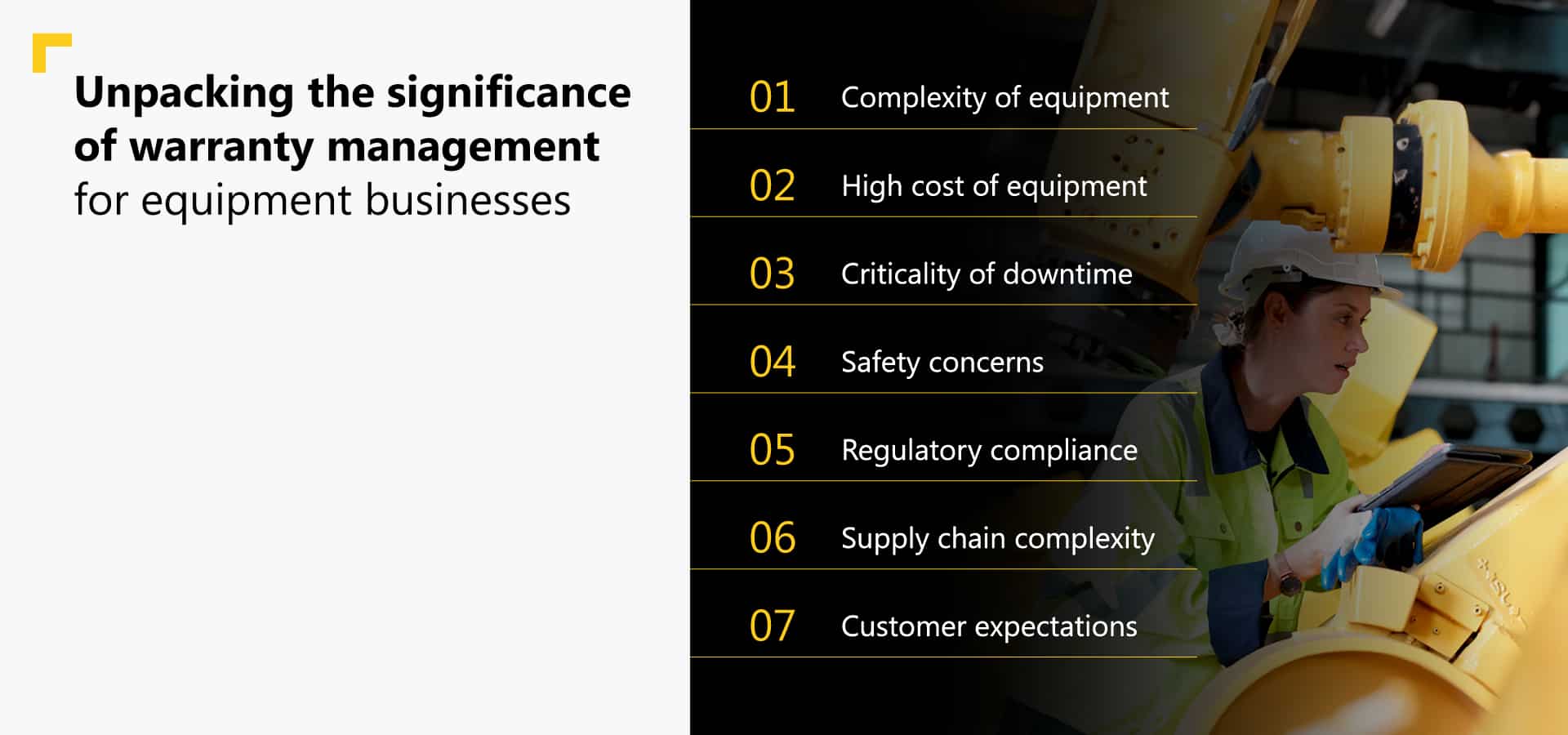
- Complexity of equipment
Equipment is known for its complexity. These machines consist of numerous intricate parts and systems that must function in precise coordination. The more complex the equipment, the higher the likelihood of mechanical failures and the need for warranty coverage. Effective warranty management is essential to address these complexities and ensure that any issues are resolved promptly.
- High cost of equipment
Equipment comes with a hefty price tag. Whether it’s an excavator or a bulldozer, these machines are significant investments for businesses. As such, any issues that arise can result in substantial financial losses. Warranty coverage helps protect these investments by covering the cost of repairs and maintenance, easing the financial burden on equipment owners.
- Criticality of downtime
In industries such as construction, mining, and agriculture, downtime is not an option. Any disruption in operations can lead to significant delays and financial losses. Warranty management plays a crucial role in minimizing downtime by ensuring that equipment is repaired quickly and efficiently. This helps businesses maintain their operations and meet their deadlines without costly delays.
- Safety concerns
Safety is paramount in equipment operations. Malfunctioning equipment can pose serious safety risks to operators and those around them. Warranty management ensures that equipment is maintained and repaired to the highest safety standards, reducing the risk of accidents and injuries.
- Regulatory compliance
Heavy equipment businesses operate under a broad range of regulations and safety standards that govern how machines are maintained, inspected, and serviced. Warranty management helps ensure that equipment meets these regulatory requirements, avoiding costly fines and penalties.
- Supply chain complexity
Equipment often requires specialized parts and components that may not be readily available. Effective warranty management involves managing the supply chain to ensure that parts are sourced and delivered quickly, minimizing downtime and disruptions to operations.
- Customer expectations
Equipment customers have high expectations when it comes to reliability and performance. Warranty management plays a crucial role in meeting these expectations by ensuring that equipment is repaired and maintained to the highest standards.
Typical warranty management practices
Equipment businesses have managed warranties using manual processes and disparate systems, which can be inefficient and error-prone. These practices often involve:
- Paper-based systems: Keeping track of warranty terms, claims, and documentation on paper, leading to delays and errors.
- Spreadsheets: Using spreadsheets to manage warranty data, which can be cumbersome and prone to data entry errors.
- Legacy systems: Using outdated software systems that may lack integration and automation capabilities, making it difficult to manage warranties effectively.
Challenges with traditional warranty management
- Limited visibility: Limited visibility into warranty data makes it challenging to track warranty terms, claims, and performance.
- Manual processes: Manual processes are time-consuming and prone to errors, leading to delays and inefficiencies.
- Lack of integration: Disparate systems and lack of integration between systems result in data silos and inefficiencies.
- Poor customer experience: Inefficient warranty management processes can lead to poor customer experience due to delays in claims processing and a lack of transparency.
Benefits of cloud-based solutions for warranty management
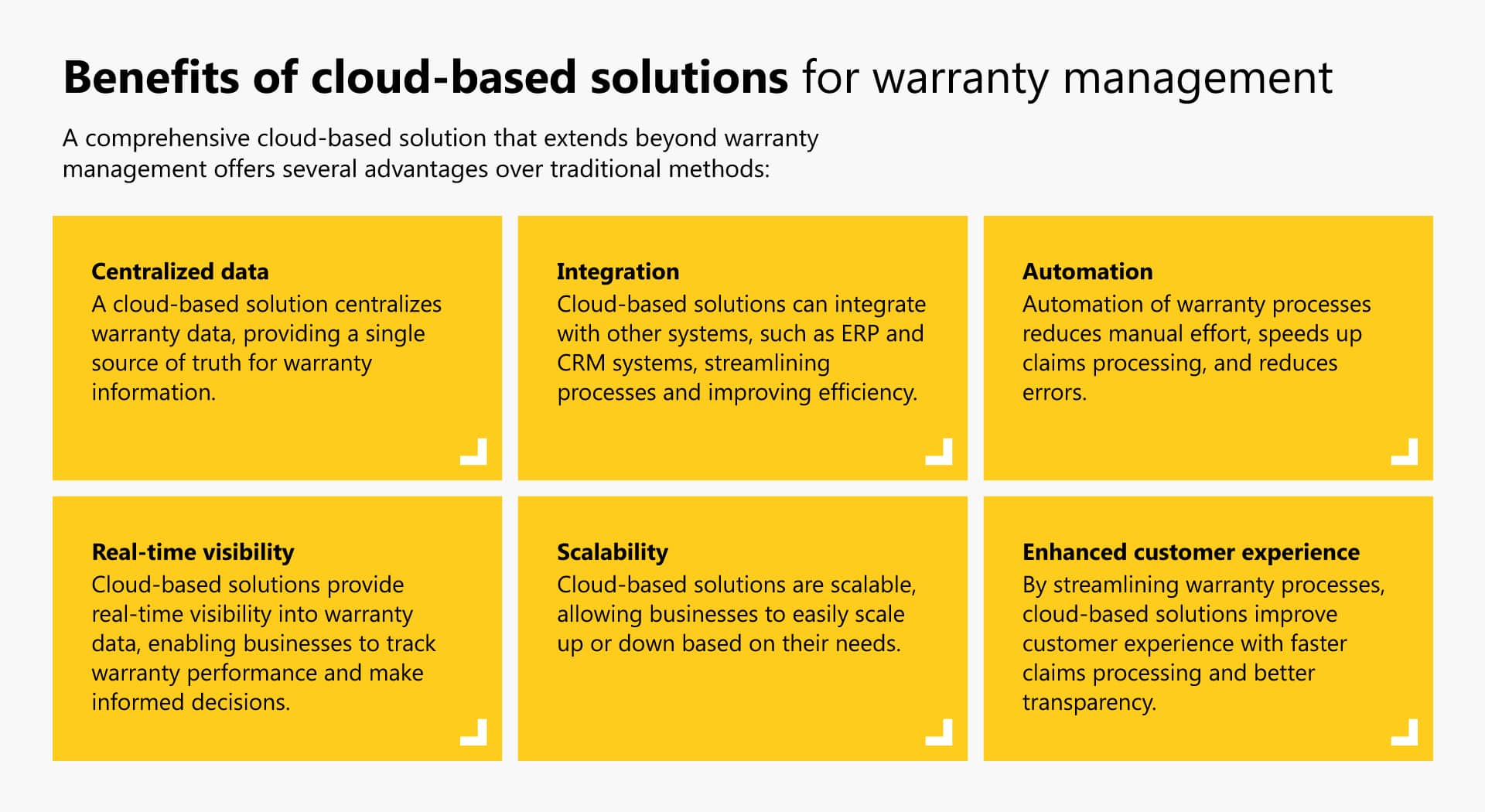
- Centralized data: A cloud-based solution centralizes warranty data, providing a single source of truth for warranty information.
- Integration: Cloud-based solutions can integrate with other systems, such as ERP and CRM systems, streamlining processes and improving efficiency.
- Automation: Automation of warranty processes reduces manual effort, speeds up claims processing, and reduces errors.
- Real-time visibility: Cloud-based solutions provide real-time visibility into warranty data, enabling businesses to track warranty performance and make informed decisions.
- Scalability: Cloud-based solutions are scalable, allowing businesses to easily scale up or down based on their needs.
- Enhanced customer experience: By streamlining warranty processes, cloud-based solutions improve customer experience with faster claims processing and better transparency.
How A365 transforms warranty management
Annata’s A365 is a comprehensive cloud-based solution that simplifies all levels of warranty management activities for equipment businesses. Designed to improve customer experience, strengthen supplier ties, reduce turnaround times, and lower aftersales service costs, A365 delivers value across the full warranty network: customers, service centers, dealerships, and OEMs.
Built on Microsoft Dynamics 365, it facilitates and streamlines warranty intelligence, fraudulent warranty claims, counterfeit equipment parts, unjustified claims management, parts inventory, and supplier recovery.
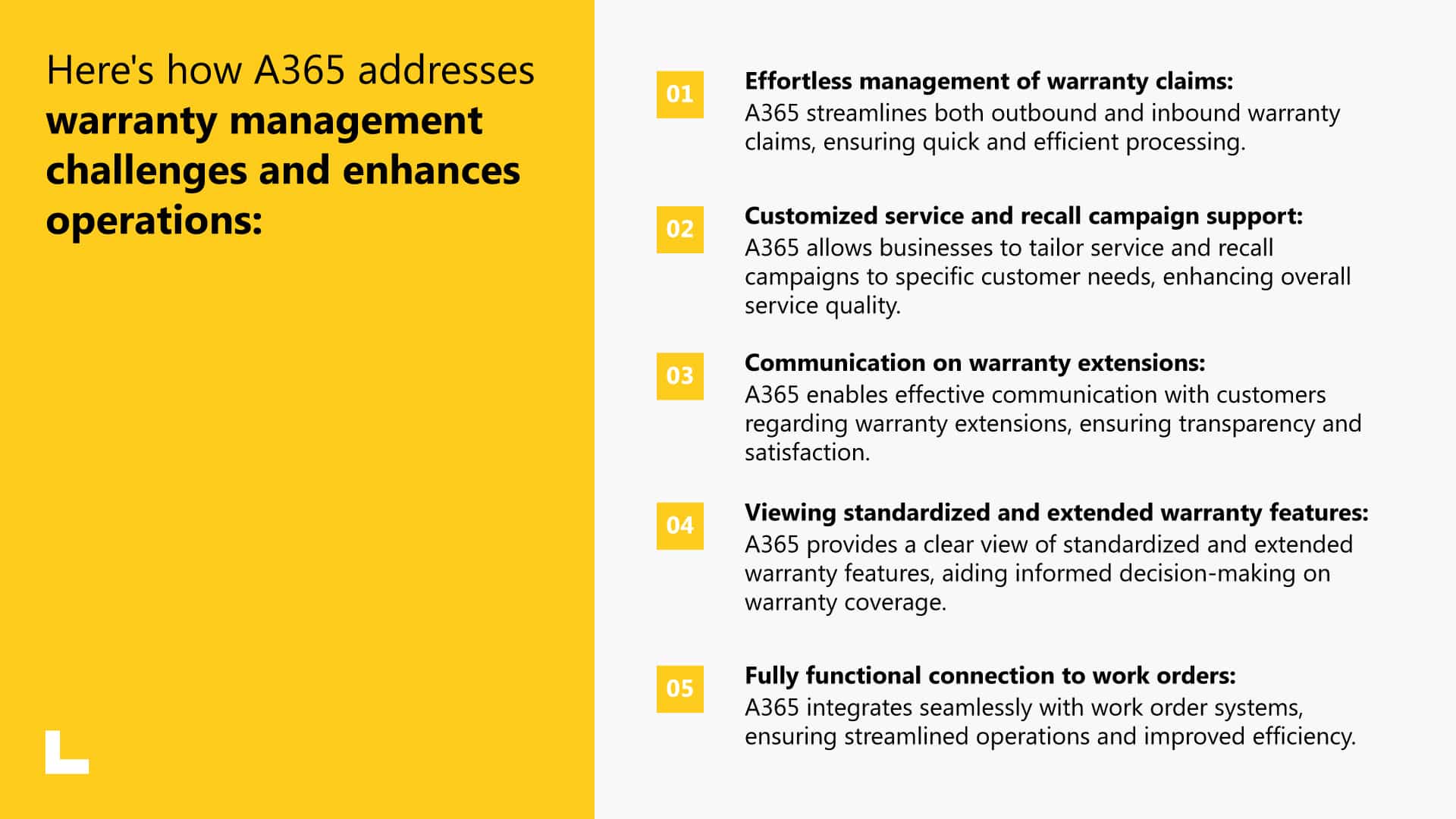
- Effortless management of warranty claims: A365 streamlines both outbound and inbound warranty claims, ensuring quick and efficient processing.
- Customized service and recall campaign support: A365 allows businesses to tailor service and recall campaigns to specific customer needs, enhancing overall service quality.
- Communication on warranty extensions: A365 enables effective communication with customers regarding warranty extensions, ensuring transparency and satisfaction.
- Viewing standardized and extended warranty features: A365 provides a clear view of standardized and extended warranty features, aiding informed decision-making on warranty coverage.
- Connected to work orders: A365 connects directly to work order systems, ensuring warranty claims and service jobs share the same data without manual re-entry or reconciliation between systems.
The power of A365’s warranty processes
A365 is built to manage the full warranty lifecycle without gaps. Claims move from submission to resolution in one connected environment, reducing manual steps and processing delays. A365 connects to your existing ERP, CRM, and service systems without requiring separate integrations, giving teams a single view of warranty status, parts availability, and supplier communication. The result is faster claim resolution, lower warranty administration costs, and consistent service quality across the dealer network.
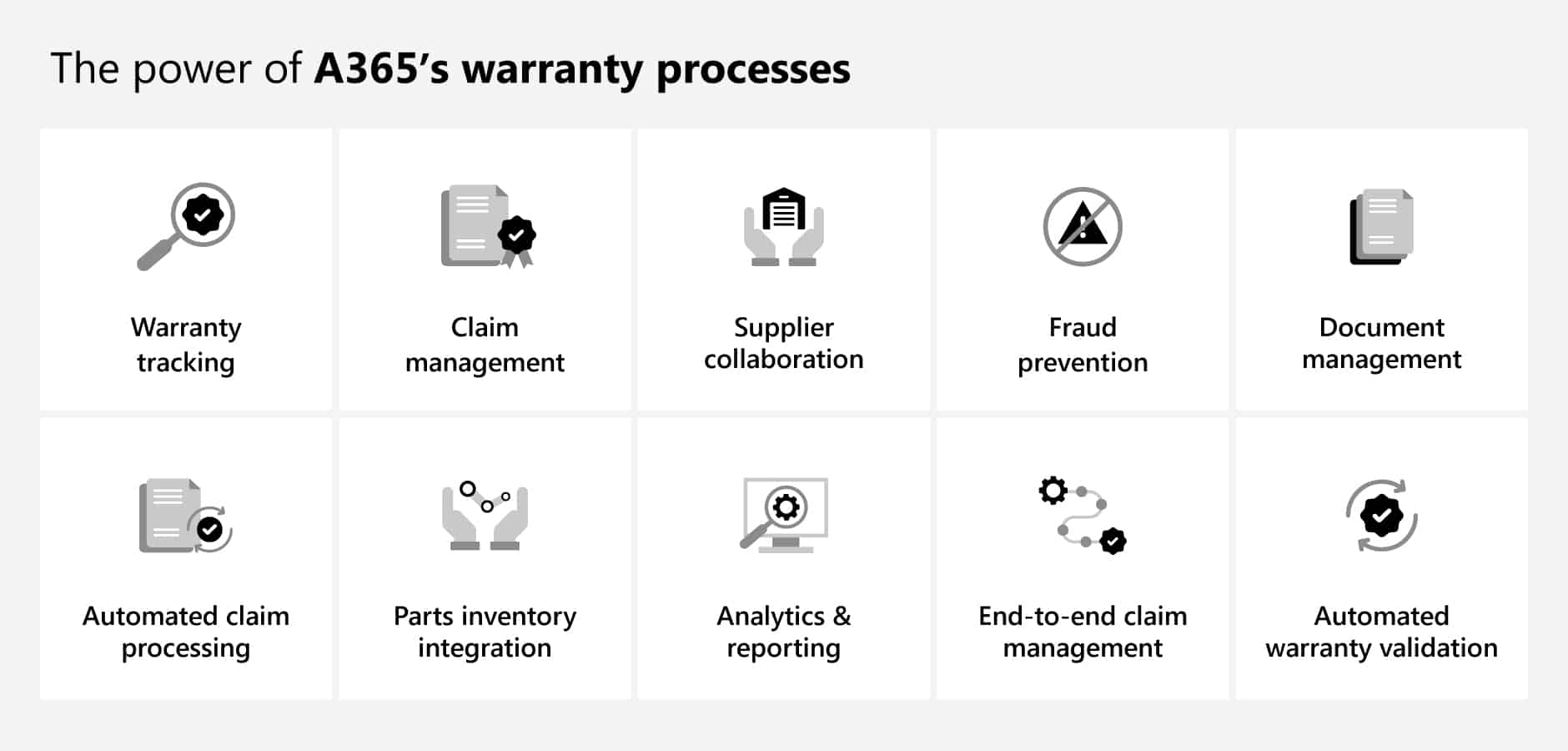
- Warranty tracking: A365 enables businesses to track warranty terms and conditions for each piece of equipment. This includes details such as warranty start and end dates, coverage information, and any specific terms or conditions associated with the warranty.
- Automated claim processing: A365 automates the process of processing warranty claims, reducing the need for manual intervention. This can lead to faster claim resolution and improved customer satisfaction.
- Claim management: A365 provides tools for managing warranty claims from initiation to resolution. This includes tracking the status of claims, communicating with customers about the progress of their claims, and ensuring that claims are resolved in a timely manner.
- Document management: A365 includes features for storing and managing warranty-related documents, such as invoices, receipts, and warranty certificates. This helps ensure that all relevant documentation is easily accessible and organized.
- Supplier collaboration: A365 facilitates collaboration with suppliers, enabling businesses to easily communicate with suppliers about warranty issues, parts availability, and other related matters. This can help ensure that warranty claims are processed quickly and efficiently.
- Fraud prevention: A365 includes features for detecting and preventing fraudulent warranty claims. This may include tools for verifying the authenticity of claims, detecting patterns of fraudulent behavior, and taking action to prevent future fraud.
- Parts inventory integration: A365 integrates with parts inventory systems, allowing businesses to easily track the availability of parts for warranty repairs. This can help ensure that parts are available when needed, reducing downtime for equipment repairs.
- Analytics & reporting: A365 provides tools for analyzing warranty data and generating reports. This can help businesses identify trends, track performance, and make informed decisions about warranty management.
- End-to-end claim management: A365 offers end-to-end claim management capabilities, ensuring that all aspects of the warranty claim process are covered. This includes claim initiation, processing, resolution, and post-claim follow-up.
- Automated warranty validation: A365 automates the process of validating warranties, ensuring that warranty claims are only processed for equipment that is still under warranty. This can help prevent unauthorized claims and reduce the risk of fraud.
Discover the capabilities of A365’s warranty management in our factsheet. For a personalized session with one of our consultants on how we can assist with your business’s warranty management needs, reach out to us today.