
Warranty management is a large-scale process for vehicle manufacturers. Covering the process from suppliers, through dealers and end customers, the large amount of data brings the possibility of errors in various levels. Every dealer and manufacturer have their own processes for managing warranty claims and data, but often the systems in place do not deliver consistent or accurate data. With the high number of parts, quantity manufactured, and complexity of the vehicles, it is unavoidable that there will be component failures from time-to-time. The ability to differentiate between expected breakdowns and systemic failures is essential to streamlining the warranty process and data flow.
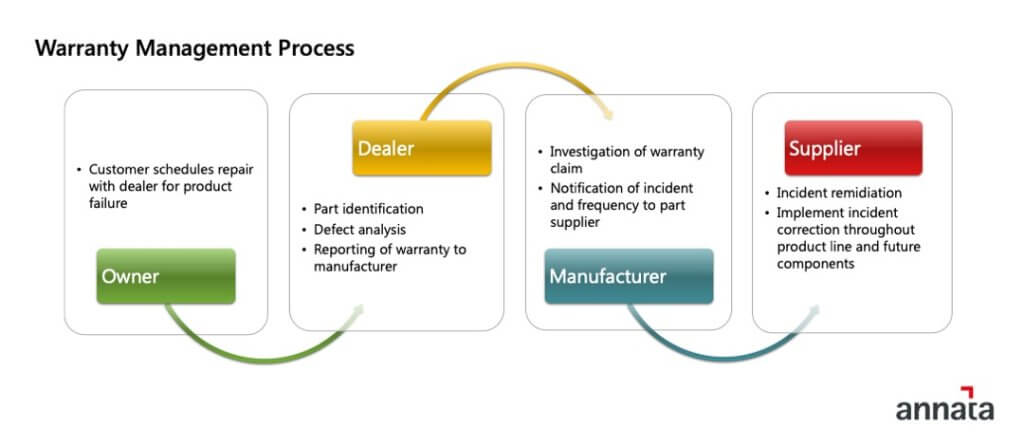
While on the surface, the process flow of warranty data seems simple and straightforward, underneath the surface the variance and disparity with which the data is collected, reported, and analyzed results in deep complexity (The Warranty Process Flow Within the Automotive Industry, Center for Automotive Research).
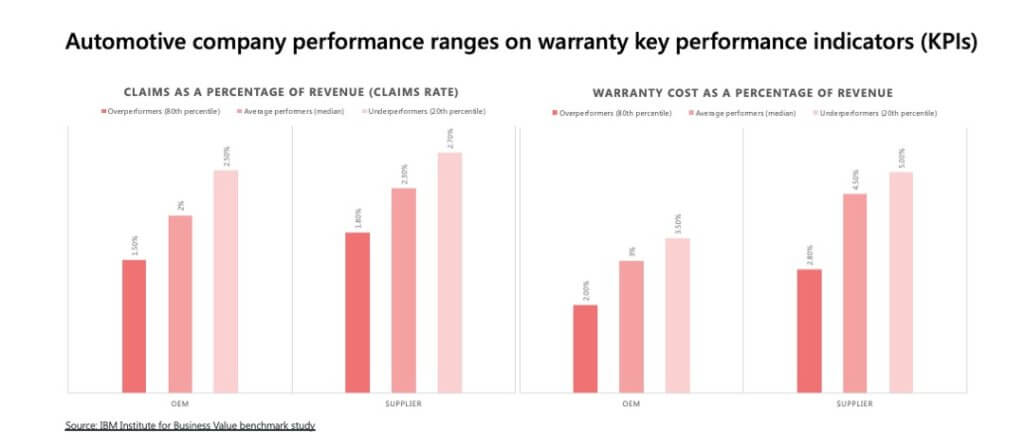
The process by which warranty data is collected and reported changes from dealer to dealer, and it is likely that OEMs will need to be prepared to handle warranty claims from both authorized dealers as well as independent technicians. Accurate and preemptive monitoring of warranty data across all touchpoints allow manufacturers to address and control escalating warranty costs. Recent IBM Institute for Business Value Research showed that on average, Automotive OEMs spent 2% of their annual revenue on paying warranty claims, but total warranty costs including operations, were closer to 3%.
How vehicle manufacturers are using data to reduce warranty exposure
Frequently, OEMs overlook warranty processes as a key to win future customers and increase customer satisfaction, and instead view the warranty process as just a necessary manufacturing process. Collecting warranty data can provide OEMs with the ability to better forecast parts usage at dealers and ensure that dealers are able to meet repair demands, thus decreasing the chance for delays in repair and increasing customer satisfaction. Managing and tracking all warranty policies for each component also enables customers and service centers to check warranty eligibility prior to starting repairs, avoiding confusion and unnecessary warranty claims.
Related reading: From isolated operations to comprehensive orchestration: Driving automotive manufacturer-dealer collaboration

The most effective warranty management solutions help businesses to effectively manage warranty claims by providing:
- Automatic warranty claim validation
- Supports service and recall campaigns
- Effortless management of outbound and inbound warranty claims
- Standardized and extended warranty features
- Fully functional connection to work orders
- Supports preliminary invoicing and pre work approval
- Smooth part return and replacement processes
- Seamless integration to dealer portal and other external interfaces
A365 is an industry vertical solution for organizations who Import, distribute, sell and service vehicles. Annata’s AI powered warranty management software enables dealers, suppliers, and OEMs to streamline warranty processes, reduce warranty costs, improve collaboration among all stakeholders, and enhance customer satisfaction. Click here to find out what makes A365 the best warranty claim management solution.
FAQ: How vehicle manufacturers can improve warranty management
Why is warranty management important for vehicle manufacturers?
Warranty costs are a significant P&L line for OEMs. Effective warranty management reduces claim leakage, identifies quality issues earlier, and strengthens the manufacturer-dealer relationship.
How can vehicle manufacturers reduce warranty management costs through analytics?
OEMs use predictive analytics to identify recurring failure patterns, prioritise quality improvements at the component level, and benchmark dealer claim submission accuracy.
What is the role of automation in vehicle manufacturers’ warranty management?
Automation streamlines claim adjudication, reduces manual review time, flags anomalous submissions, and accelerates reimbursement, benefiting both manufacturers and dealers.
How do vehicle manufacturers coordinate warranty with dealers?
Leading OEMs provide dealers with integrated warranty portals, pre-submission validation tools, real-time claim status tracking, and performance dashboards to improve claim quality and processing speed.
ABOUT ANNATA
Annata offers a range of artificial intelligence and machine learning solution accelerators to solve business problems and facilitate business processes for the automotive industries. The A365 business solution and the Microsoft Power Platform empowers automotive dealers and manufacturers to make data driven decisions that are guaranteed to increase the operational efficiency of the business. Annata Analytics provides businesses with direct access to a large amount of information which enables them with a better idea about their customers and connect with each customer on a more personal level. Get to know more about Annata’s warranty management software. Contact us now.
Vehicle manufacturer warranty management involves: (1) claim receipt and validation from dealer network, (2) automated adjudication and anomaly detection, (3) technical review for complex or high-value claims, (4) parts return and inspection workflows, (5) reimbursement processing, and (6) quality feedback loops to engineering. In 2026, leading OEMs are integrating AI-powered audit tools, predictive cost modelling, and real-time dealer scorecards into their warranty operations.