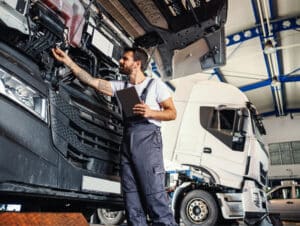
For many businesses operating in trucks & buses and the wider commercial vehicles space, “lifecycle management” sounds good on paper, but in reality, it’s messy.
Different systems. Disconnected data. Reactive decisions.
And the result? You’re not really managing the lifecycle. You’re constantly trying to catch up with it.
The problem: When systems don’t talk, operations suffer
Most commercial vehicle businesses didn’t design their systems to work together. Over time, they’ve layered:
- An ERP for finance and operations
- A DMS for dealer and service management
- A CRM for sales and customer engagement
Individually, they work. Together? Not so much.
Data sits in silos. Teams operate in isolation. And critical information like vehicle history, service records, and customer interactions gets fragmented across systems.
This disconnect creates real consequences for commercial vehicle lifecycle management, including:
- Delays in service and parts availability
- Limited visibility into vehicle performance
- Poor coordination between departments
- Missed opportunities to upsell or retain customers
What you end up with is operational friction at every stage of the lifecycle.
From reactive to predictive: A necessary shift for commercial vehicle lifecycle management
Traditionally, commercial vehicle lifecycle management has been reactive.
A vehicle breaks down, you fix it. A customer complains, you respond. A part runs out, you reorder.
But that model doesn’t hold up anymore.
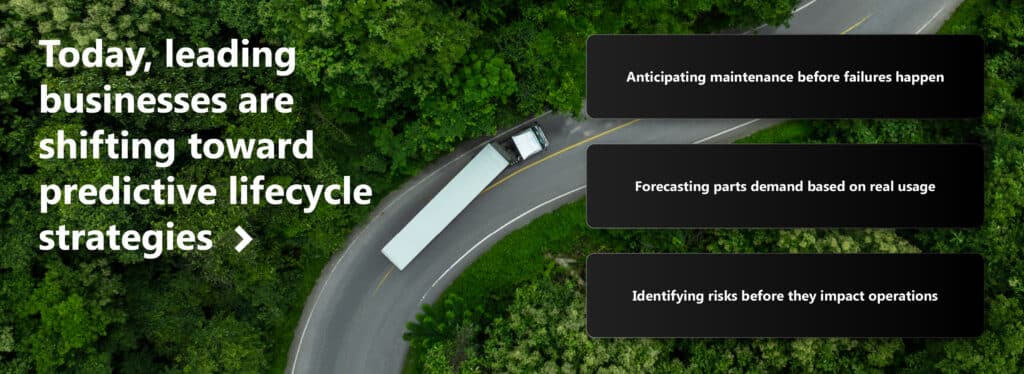
This shift is not just about technology. It’s about control. Moving from firefighting to foresight.
Connecting every point of the commercial vehicle lifecycle management
This is where A365 changes the game for truck and bus businesses.
Built on Microsoft Dynamics 365 and other technologies from the Microsoft ecosystem, including Azure, Copilot, Power Platform, and Dataverse, A365 Trucks & buses brings commercial vehicle Enterprise Resource Planning (ERP), Dealer Management System (DMS), and Customer Relationship Management (CRM) capabilities into a single, connected commercial vehicles management system.
It’s an integrated business platform that brings everything under one roof. Instead of stitching systems together, it unifies them for end to end commercial vehicle lifecycle management.
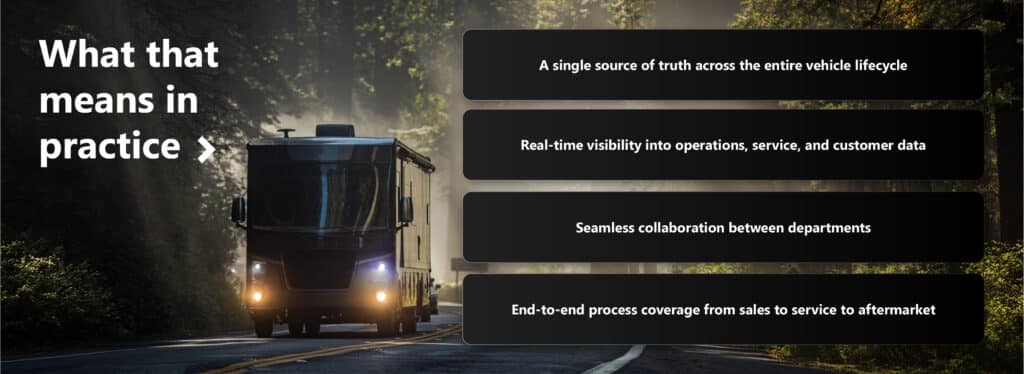
No more switching between systems. No more guesswork.
Just connected control.
Automating what slows you down
Manual processes are one of the highest hidden costs in lifecycle management.
Think approvals. Service workflows. Data entry. Reporting.
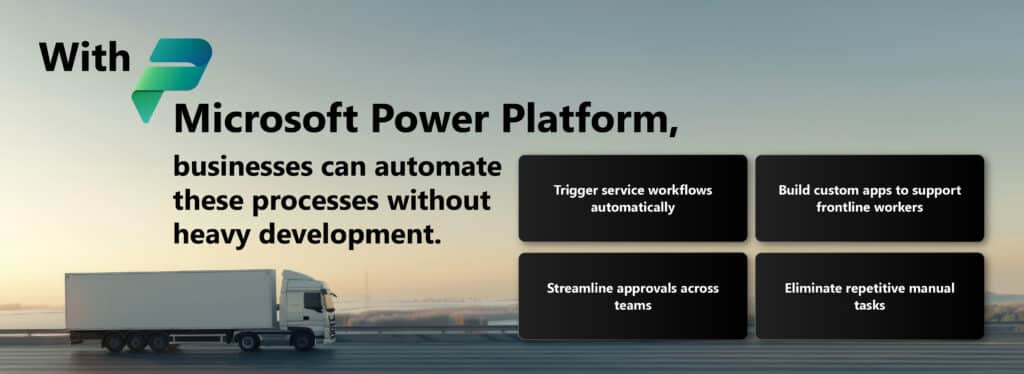
The result? Faster operations, fewer errors, and more time focused on what actually matters.
Smarter decisions with AI and Copilot
Data alone is not enough. You need to act on it fast.
That is where AI and Microsoft Copilot come in.
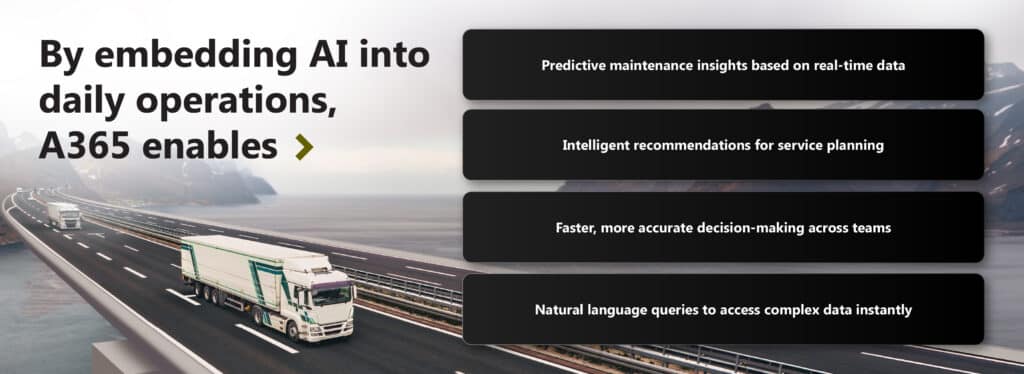
Instead of digging through reports, your teams get answers when they need them.
Why evergreen matters more than ever
One of the biggest risks in this industry is not just inefficiency. It’s stagnation.
Traditional systems age quickly. Updates are costly. Innovation slows down.
An evergreen architecture changes that.
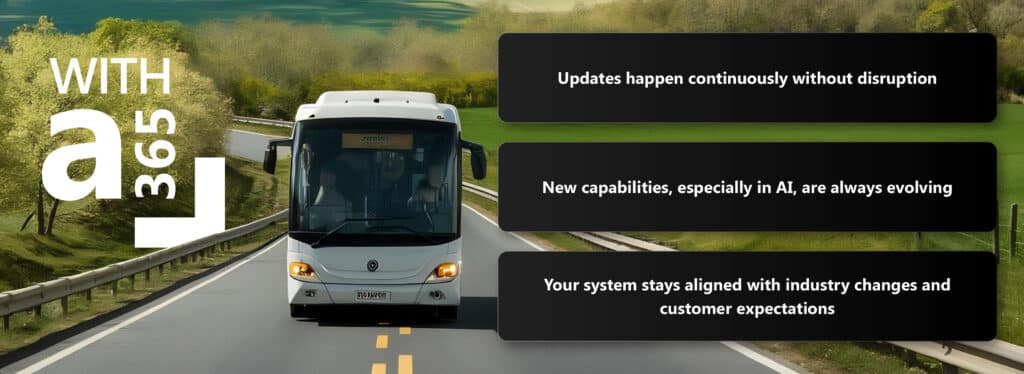
Instead of just implementing a solution, you’re investing in a platform that grows with your business.
From chaos to control
Commercial vehicle lifecycle management does not have to be complex.
But it does require a shift:
- From disconnected systems to a unified platform
- From reactive responses to predictive strategies
- From manual processes to intelligent automation
With A365, commercial vehicle lifecycle management can finally move from operational chaos to connected control.
And in an industry where uptime, efficiency, and customer experience define success, that shift is no longer optional.
See it in action
Curious how this could look in your business?
Visit the Digital Experience Center to explore how A365 brings commercial vehicle lifecycle management to life across trucks & buses and commercial vehicle operations. See how connected data, AI-driven insights, and an evergreen platform come together to help you move faster, operate smarter, and stay ahead.
Want a 1:1 personalized session? Speak to us today to understand how A365 can support your truck and bus lifecycle management needs.