
It’s a Monday morning. A customer calls asking whether the vehicle they enquired about last week is still available. The salesperson checks the DMS. The stock record is there, but there’s no note about the enquiry. They switch to the CRM. The follow-up is logged, but there’s no link back to the vehicle. By the time they’ve got the full picture, the customer has already moved on to someone who answered faster.
That’s not a people problem. The salesperson did everything right. The systems just weren’t built to work together.
This happens dozens of times a week in dealerships running an automotive DMS that isn’t connected to the rest of the business. And because each instance feels small in the moment, the real cost rarely gets added up.
The gaps that don’t show up in any report
The data your dealership needs to run well is almost certainly already there. It’s in the automotive DMS, the CRM, the service system, the finance platform. The problem is that it sits in all of those places separately, and nobody has the full picture without going to look for it.
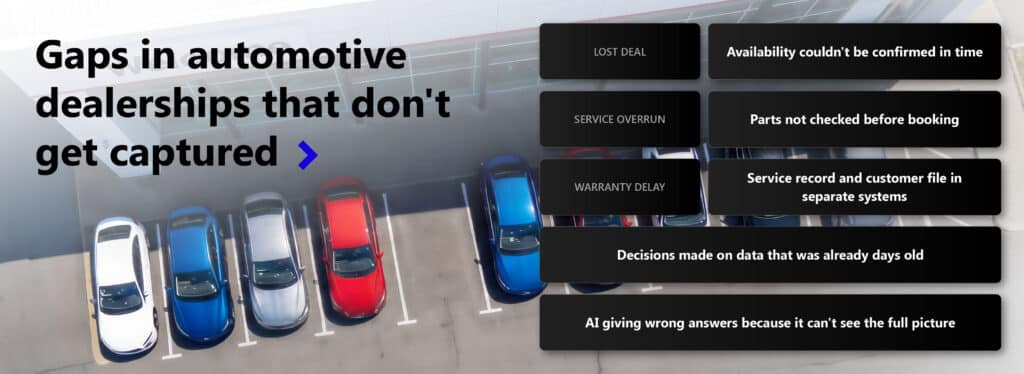
That creates gaps that never get captured anywhere:
- A deal that stalled because the salesperson couldn’t confirm availability fast enough
- A service job that ran over because parts weren’t checked before the booking was confirmed
- A warranty claim that took three days longer because the service record and customer file were in different places
- A manager making a call on staffing or stock based on numbers that were already two days out of date
- An AI tool that keeps surfacing the wrong things because it can’t read across your systems
None of these show up as a line item. They show up as a feeling that the dealership is working harder than it should be and still not moving as fast as the team knows it could.
Why slow decisions are costing more than you think
In automotive retail, the window for a decision is often measured in minutes, not hours. A customer who walks out without buying because the answer took too long doesn’t usually come back. A service booking that gets delayed because of a parts conversation that should have happened before the appointment doesn’t show up as a lost opportunity. It just shows up as a slightly frustrating day.
But multiply those moments across a week, a month, a quarter, and the pattern becomes clear. Dealerships that can answer faster, schedule smarter, and give their managers a live view of what’s happening are consistently outperforming the ones that can’t.
The gap isn’t effort. Most dealership teams are working hard. The gap is visibility. And visibility comes from connected systems, not from working harder inside disconnected ones.
Is your automotive DMS working for you or around you?
Before we get into what better looks like, it’s worth being honest about where your dealership actually stands right now:
Your automotive DMS probably has a problem if…
Reports take hours to pull together. Your team checks more than one system just to answer a basic customer question. Service and sales data don’t connect. AI tools you’ve added feel like they’re guessing. Leadership asks for numbers that should already be visible. And the thought of changing an automotive DMS feels too risky to even consider.
You’re in a good place if…
Stock, customer, and service data is visible in one place. Your team starts the day knowing exactly where everything stands. Decisions get made on live data, not last week’s spreadsheet. AI surfaces the right information at the right moment. Adding a new site or capability doesn’t mean rebuilding. And your DMS connects to ERP and CRM without custom workarounds.
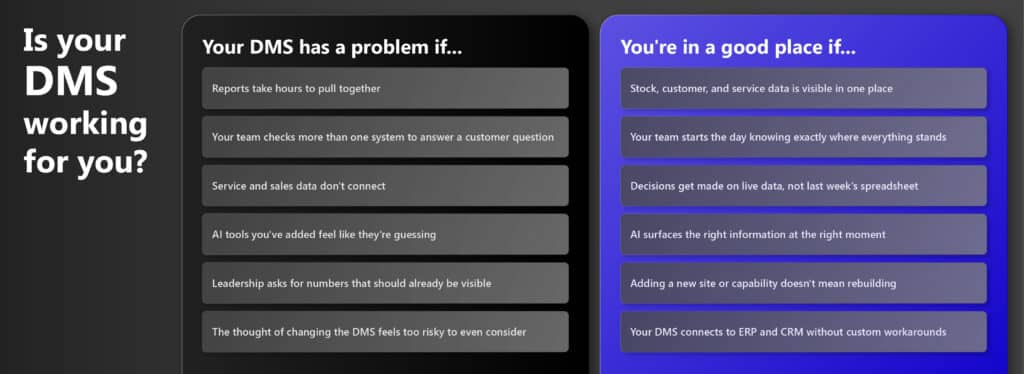
If the left column sounds familiar, the issue probably isn’t your automotive DMS itself. It’s that your DMS isn’t connected to the rest of the business. And that’s a solvable problem.
This is why we built A365 differently
We didn’t build A365 from a whiteboard. We built it from conversations.
Some of us came directly from the automotive industry. We’d sat in dealerships, watched how the day actually ran, seen where the friction was, and felt the frustration of systems that were supposed to help but kept getting in the way. We knew what a Monday morning looked like when the numbers weren’t ready, when a customer was waiting while someone checked three different screens, when the workshop was running blind because the parts system didn’t talk to the service system.
And for those of us who came from the technology side, we spent a lot of time in dealerships before we wrote a single line of code. We sat with sales managers, service managers, finance controllers, and dealer principals. We asked them what slowed them down, what kept them up at night, what they wished their systems could do. Those conversations shaped every decision we made about how A365 works.
What we kept hearing was the same thing: the data is there. We just can’t get to it when we need it. So we built A365 to fix exactly that.
A365 is built natively on Microsoft Dynamics 365, which means it doesn’t connect to your existing Microsoft environment through workarounds or middleware. It’s already part of it. The tools your team uses every day, including Teams, Outlook, Power BI, and Excel, work alongside A365 without any custom integration work. And because everything runs on Azure, Copilot, Power Platform, and Dataverse, at the core, your DMS, CRM, and ERP all share the same data from the moment you go live.
That’s not a technical detail. That’s the thing that changes how your dealership runs every single day.
What connecting your automotive DMS actually changes
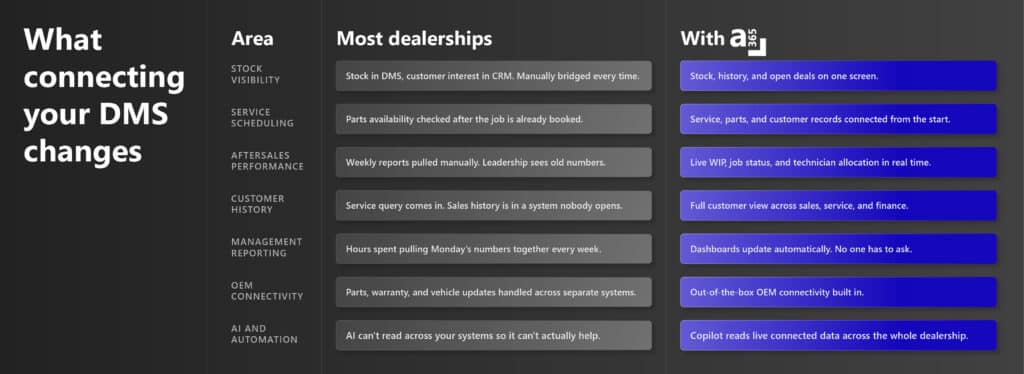
Here’s what the shift looks like in practice across the key areas of a dealership:
Stock visibility
In most dealerships, stock lives in the DMS and customer interest lives in the CRM. Every time a salesperson needs the full picture, they bridge the two manually. With A365, stock, customer history, and open deals are visible on one screen. No bridging needed.
Service scheduling
Service bookings typically don’t connect to parts availability. The conversation about whether the right parts are in stock happens after the job is already confirmed. With A365, service, parts, and customer records are connected from the start. No surprises on the day.
Aftersales performance
Workshop reports get pulled manually at the end of the week. By the time leadership sees the numbers, they’re already old. With A365, job status, WIP, and technician allocation update in real time. The picture is always current.
Customer history
When a customer comes in with a service query, their full history is usually in a different system that nobody opens in the moment. With A365, the complete customer view across sales, service, and finance is visible to everyone who needs it, right there and then.
Management reporting
Someone spends hours every week pulling together the numbers leadership asks for every Monday morning. With A365, dashboards update automatically. Leadership sees what’s happening without having to ask.
OEM connectivity
Parts ordering, warranty claims, and vehicle updates currently require manual steps across separate systems. With A365, OEM connectivity for parts ordering, warranty processing, and vehicle configuration updates is built in out of the box.
AI and automation
Most AI tools sit on top of the DMS but can’t read the data they actually need to help. With A365, AI through Microsoft Copilot works inside the workflow, reading live connected data across the whole dealership — not guessing from isolated sources.
Each of these, on its own, is a meaningful improvement. Together, they add up to a dealership that’s running the way it should have been running for years.
What a modern automotive DMS needs to do
A basic system isn’t enough anymore. To stay ahead in automotive retail, your DMS needs to do more than process transactions. Here’s what A365 delivers as standard, and what each of those capabilities actually means for the people using it every day:
- Unified inventory management — Complete visibility across new, used, and trade-in vehicles, plus granular parts and accessories tracking across every location
- Real-time deal desking and F&I — Taxes, financing, and insurance calculated instantly so customers aren’t kept waiting while numbers are worked out
- Advanced workshop and service scheduling — Automated capacity planning, technician time-clocking, and digital repair orders that maximise service bay profitability
- Native CRM integration — Every employee sees the full customer and vehicle lifecycle in one place, from first enquiry to repeat service
- Robust OEM connectivity — Out-of-the-box parts ordering, warranty claim processing, and vehicle configuration updates direct from the manufacturer
- Cloud-native architecture — Secure, mobile-friendly access for appraisals on the lot and service approvals from a tablet, not just from a desk
- Embedded AI and analytics — Built-in intelligence that predicts stock gaps, highlights service trends, and delivers leadership dashboards without third-party tools
- Telematics and IoT readiness — Connected vehicle data triggers automated service reminders before the customer is even aware of an issue
- Omnichannel digital retailing — Online reservations connect directly to the in-store finance process for a consistent experience however the customer arrived
- Enterprise-grade security — Compliance protocols, automated backups, and multi-factor authentication protecting your data at all times
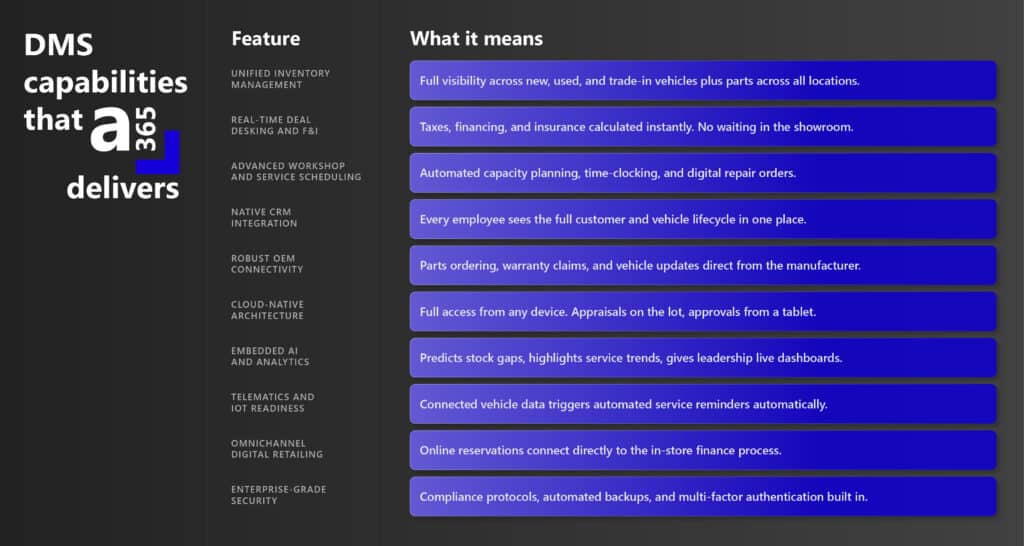
These aren’t features added on top of a legacy platform. They’re built into A365 from the ground up, which means they work together rather than alongside each other.
A365 vs. a typical standalone automotive DMS
To put it plainly, here’s how A365 compares to a traditional, isolated DMS:
Technology foundation
A typical standalone DMS runs on aging, proprietary architecture that’s difficult to scale. A365 is cloud-native, built on Microsoft Dynamics 365, and updated continuously with no legacy constraints, no ceiling on growth.
Data ecosystem
Most standalone systems sit on an isolated database that requires complex, costly third-party integrations to connect to anything else. A365 uses a unified Dataverse that connects ERP, CRM, and DMS workflows out of the box, from day one.
Artificial intelligence
A traditional DMS limits AI to basic reporting and manual data extraction. A365 has embedded AI and Microsoft Copilot built in, delivering predictive insights and task automation inside the workflows your team already uses.
User experience
Outdated interfaces mean extensive training every time a new member of staff joins. A365 mirrors the Microsoft tools most dealership teams already know, so adoption is faster and the learning curve is significantly shorter.
System updates
With a typical standalone DMS, updates arrive as disruptive, expensive upgrade projects that cause downtime. A365 delivers continuous evergreen updates without disruption, the system improves without the dealership having to stop to accommodate it.
OEM connectivity
Legacy systems rely on custom-coded, fragile point-to-point API connections that break and require maintenance. A365 uses standardised integrations built specifically for the automotive industry from the ground up, robust, reliable, and ready from the start.
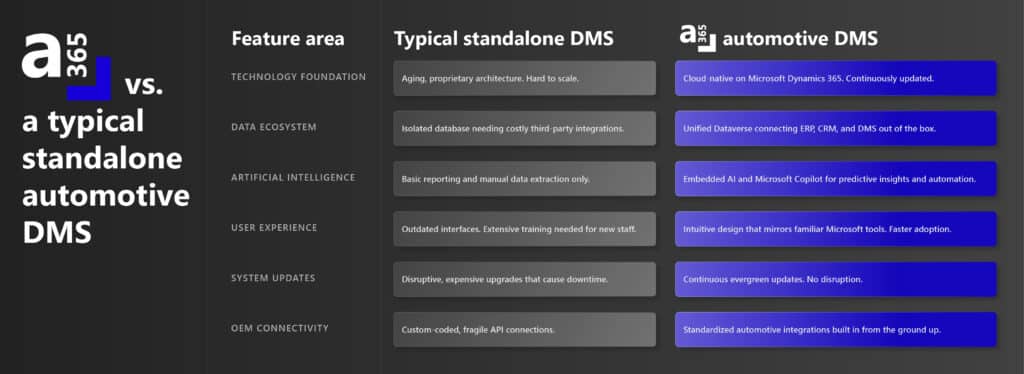
The difference isn’t just in the features. It’s in the foundation. A traditional DMS was built to handle transactions. A365 was built to connect them to everything else that matters.
What a connected automotive dealership looks like day to day
When DMS, CRM, and ERP work as one platform, the difference isn’t theoretical. It shows up in how the dealership runs on an ordinary Tuesday.
Your sales team starts the day with a live view of stock, customer history, and open opportunities in one place. No switching between systems before a customer conversation.
Your service team can see which jobs are open, what parts are needed, and whether anything is going to cause a delay, before the customer arrives, not after.
Your aftersales manager sees workshop performance, technician utilization, and WIP status in real time. The Monday morning numbers are already there when they sit down.
Your finance team has visibility of deals in progress, outstanding payments, and contract status without waiting for someone to send a file.
And AI through Microsoft Copilot works the way it’s supposed to, surfacing the right information at the right moment inside the workflow your team is already using, because it’s reading live, connected data through Power Platform and Dataverse.
Frequently asked questions
What is an automotive dealer management system (DMS) for dealerships?
A dealer management system, or DMS, is the core operational platform that automotive dealerships use to manage stock, sales transactions, service bookings, and customer records. The problem most dealerships face is that their DMS doesn’t connect to their CRM or ERP, which means data stays in silos and decisions slow down.
Why isn’t my dealership DMS giving us the visibility we need?
Most DMS platforms manage transactions well but weren’t built to share data across sales, service, and finance in real time. When your DMS doesn’t connect to your CRM and ERP, your team ends up checking multiple systems to get the full picture, and by the time they do, the moment to act has often already passed.
How does A365 connect to an automotive dealership’s existing systems?
A365 is built natively on Microsoft Dynamics 365, which means it doesn’t need middleware or custom integrations to connect with the Microsoft tools your team already uses. DMS, CRM, and ERP all share the same data layer through Microsoft Azure and Dataverse, so everything is visible in one place from day one.
Is it risky to change a dealership management system?
It feels that way because the DMS is woven into how a dealership operates. A365 is built on the Microsoft stack most automotive businesses are already running, which makes the transition significantly less disruptive than moving to an unfamiliar platform. The goal isn’t to rebuild from scratch. It’s to connect what’s already there and extend it with capabilities that were missing.
How does AI help automotive dealerships with their DMS?
AI through Microsoft Copilot, built into A365 via Power Platform and Dataverse, surfaces insights, flags issues, and supports decisions inside the workflow your team already uses. It works because it’s reading live, connected data across the dealership, not guessing from separate sources that were never designed to talk to each other.
What features should an automotive DMS include?
A modern automotive DMS should include unified inventory management, real-time deal desking, native CRM integration, advanced service scheduling, OEM connectivity, embedded AI and analytics, cloud-native architecture, omnichannel digital retailing, telematics readiness, and enterprise-grade security. A365 includes all of these as standard, built on Microsoft Dynamics 365.
What’s the difference between a connected DMS and a standalone DMS?
A standalone automotive DMS handles the transaction but doesn’t share data with the rest of the business. A connected DMS, like the one inside A365, means stock, customer history, service records, and financial information are visible to the right people at the right time, without anyone having to pull it together manually.
Powering Possibilities means your dealership has the visibility to move faster, decide better, and serve customers the way they actually expect to be served.
See what a connected dealership looks like for your operation
Every dealership runs differently. Book a personalized demo and we’ll show you exactly what A365 looks like inside your specific operation, not a generic walkthrough.
Book your personalized demo today.