There’s a scene that plays out in dealerships every weekend.
A customer walks in on Saturday morning. They called on Wednesday. Spoke to someone. Named a model, discussed a price, maybe floated a finance question. They’ve done the hard part. They’ve decided.
And the first thing your salesperson asks them?
“So, what are you looking for today?”
That’s not a Customer Relationship Management (CRM) software failure. That’s a structural one. And it’s costing you deals.
The real reason automotive CRM underdelivers
The automotive CRM industry will tell you the answer is better features. More automation. Smarter pipelines.
It isn’t.
The reason automotive CRM underdelivers is simpler and harder to fix with a software update: your CRM was never designed to live inside an automotive business. It was designed to sit in front of one.
It captures leads. It logs calls. It tracks where someone is in a pipeline.
But automotive doesn’t stop at the sale. It moves into stock, into allocation, into delivery windows, workshop schedules, parts availability, warranty, and lifecycle service. A CRM that can’t see any of that isn’t a CRM. It’s a contact list with a sales view.
So your team does what they always do. They switch tabs. They check the DMS. They call the desk. They guess. By the time they have the full picture, the customer’s energy has shifted.
Not because your people aren’t good. Because your systems make it impossible for them to be.
What “Integrated Automotive CRM” actually means (and what it doesn’t)
Integration has become a meaningless word in automotive software. Every vendor claims it. Most mean: we have an API, and if someone builds a connector, data will sync. Eventually. Partially. Unreliably.
That’s not integration. That’s reconciliation. You’re still running disconnected systems and paying someone to paper over the gaps.
Real integration means CRM, ERP, and DMS operating from a single data model. Not syncing after the fact, but never being separate in the first place.
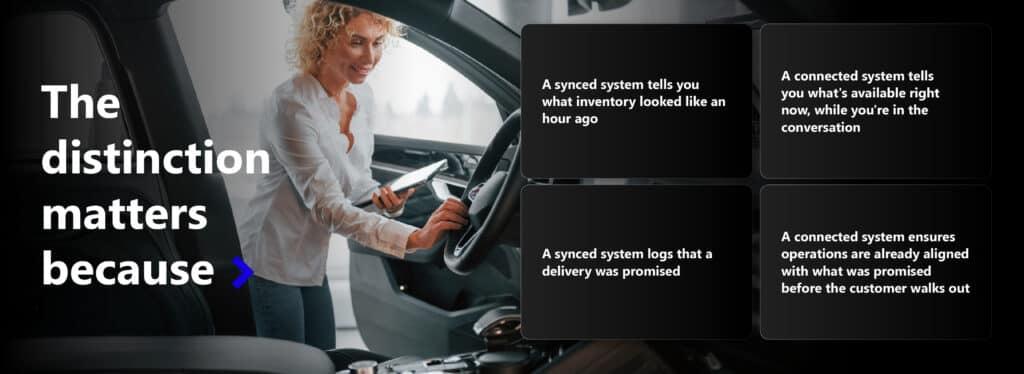
This is the difference between a CRM that records your business and one that actually runs inside it.
Why Microsoft Dynamics 365 for automotive changes the question
A365 wasn’t built by adding automotive modules to a generic CRM. It was built as an automotive platform where CRM, ERP, and DMS share the same operational foundation on Microsoft Dynamics 365, running on Azure.
That architectural decision changes what’s possible.
When a lead is created, it already has real vehicle data attached. Not a placeholder. Not a field to fill in later. Actual stock, with actual availability.
When a salesperson discusses options, they’re not calling over their shoulder or switching to another screen. They’re working from a live operational context. The same data the delivery team sees. The same data that the workshop sees.
When a deal moves forward, the rest of the business already knows. There’s no handover email. No “just confirming what was agreed.” The agreement is already in the system.
And because A365 sits on the Microsoft stack, your teams aren’t learning something foreign. They’re working in an environment that connects naturally to the tools they already use, with Microsoft Copilot embedded across workflows and Microsoft Power Platform for automation, custom apps, and real-time reporting.
What this looks like on a saturday morning
Same customer. Same Saturday.
But this time, your salesperson opens a single workspace. They see the original enquiry, the model discussed, current stock levels, alternatives based on live inventory, delivery timelines tied to actual operational data.
The conversation picks up where it left off.
No friction. No repetition. No moment where the customer wonders whether anyone actually listened.
That’s not a better CRM. That’s a connected one.
The full customer lifecycle, without the gaps
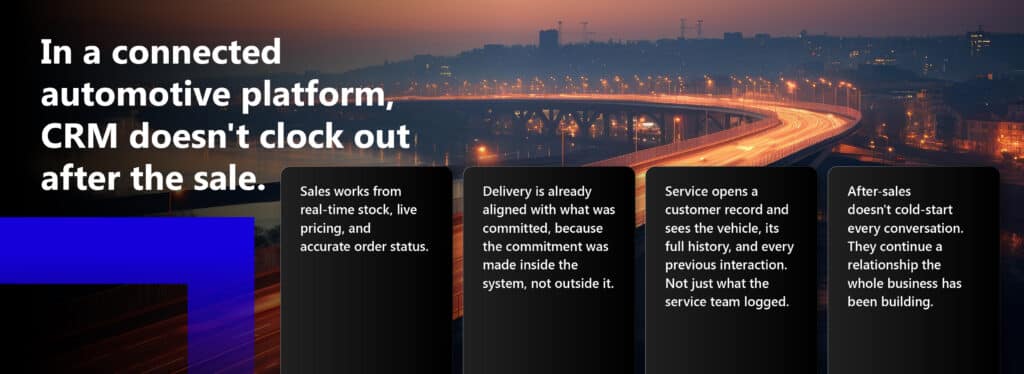
Instead of four departments each running their own version of the customer story, you get one continuous thread.
Where AI fits and where it doesn’t
Deloitte says generative AI can reshape automotive customer engagement through CRM, but while many organizations are experimenting, few have embedded it into connected CRM systems where it can drive real business outcomes.
In automotive, AI is only useful when it’s grounded in operational reality. A model that can see your CRM data but not your DMS is going to give you confident, plausible, wrong answers.
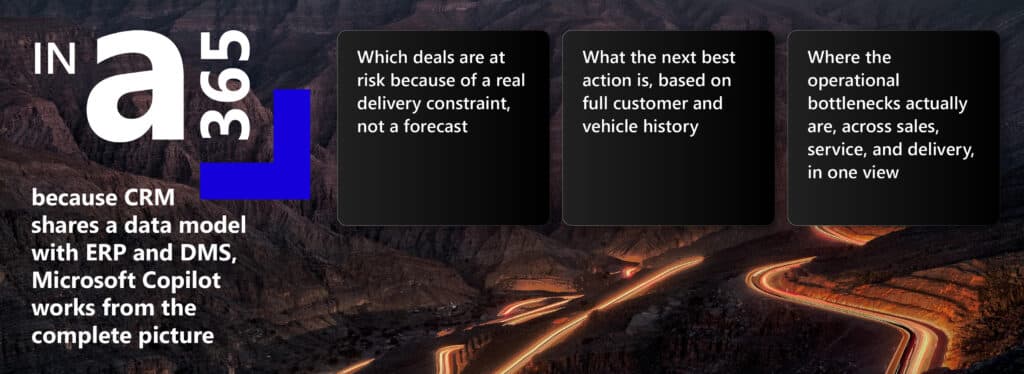
That’s not AI layered on top. That’s AI running inside a system that actually knows what’s happening.
The uncomfortable question
If your automotive CRM feels like it’s underdelivering, the instinct is to blame adoption, or training, or the platform’s feature set.
But ask a harder question: does your CRM know what your DMS knows? Does it know what your ERP knows? Can a salesperson on a Saturday morning see everything that matters, without switching systems, without asking around, without piecing it together from three sources?
If the answer is no, you don’t have a CRM problem. You have an architecture problem.
And the fix isn’t a better standalone CRM.
It’s a platform where CRM was never standalone to begin with.
A365 is built on Microsoft Dynamics 365, Azure, Copilot, Power Platform, and Dataverse, purpose-built for automotive dealer groups. If you’re evaluating automotive CRM software, DMS/ERP integration for dealerships, or Microsoft Dynamics 365 for automotive, speak to the team.
FAQ: Automotive CRM & connected dealership operations
What is automotive CRM software? Automotive CRM software manages customer relationships across the dealership lifecycle, from lead capture through sales, delivery, and after-sales service. Unlike generic CRM platforms, purpose-built automotive CRM connects to DMS and ERP systems, so salespeople work from live stock, pricing, and operational data rather than switching between disconnected systems.
Why do most automotive CRM systems underdeliver? Most automotive CRM platforms were designed to sit in front of a dealership’s operations, not inside them. They capture leads and track pipelines, but cannot see real-time inventory, workshop schedules, or delivery commitments. When CRM and DMS do not share the same data, salespeople are left switching tabs and guessing, which costs deals.
What is the difference between CRM integration and CRM connection in automotive? Integration typically means two separate systems syncing data after the fact, often delayed, partial, or unreliable. A connected CRM shares a single data model with ERP and DMS from the start, so there is no sync lag. A salesperson sees live inventory availability during a customer conversation, not what the stock looked like an hour ago.
What is Microsoft Dynamics 365 for automotive dealerships? Microsoft Dynamics 365 for automotive (A365) is an industry-specific platform where CRM, ERP, and DMS operate on a shared data foundation built on Azure. Unlike generic CRM platforms with automotive modules bolted on, A365 was purpose-built for dealer groups, with Microsoft Copilot, Power Platform, and Dataverse embedded across sales, service, delivery, and after-sales workflows.
How does AI improve automotive CRM performance? AI in automotive CRM is only effective when it has access to complete operational data. When CRM, ERP, and DMS share a single data model, AI tools like Microsoft Copilot can identify deals at risk due to real delivery constraints, recommend next best actions based on full vehicle and customer history, and surface bottlenecks across sales, service, and delivery in one view. AI layered on top of disconnected systems produces confident but unreliable outputs.
What should automotive dealerships look for in an automotive CRM platform? Dealerships should prioritize platforms where CRM, DMS, and ERP share a common data model rather than syncing separately. Key questions to ask: Can a salesperson see live inventory without switching systems? Does the delivery team see what was committed at the point of sale? Does the service team see the full customer and vehicle history, not just what they logged themselves? If the answer to any of these is no, the issue is architectural, not a feature gap.
How does connected CRM support the full automotive customer lifecycle? In a connected automotive platform, CRM remains active across every stage. Sales work from real-time stock and pricing. Delivery is already aligned with commitments made at the point of sale. Service opens a complete customer and vehicle record. After-sales continues a relationship that the whole business has been building. Instead of four departments running separate versions of the customer story, there is one continuous thread.