AI for commercial vehicle operations is talked about almost everywhere in the industry.
Truck and bus operators are being told that AI will improve maintenance planning, optimize parts inventory, automate customer interactions, and help teams make faster decisions. Vendors promise smarter operations, better forecasting, and increased productivity across the board.
Yet many organizations find themselves stuck after the pilot stage.
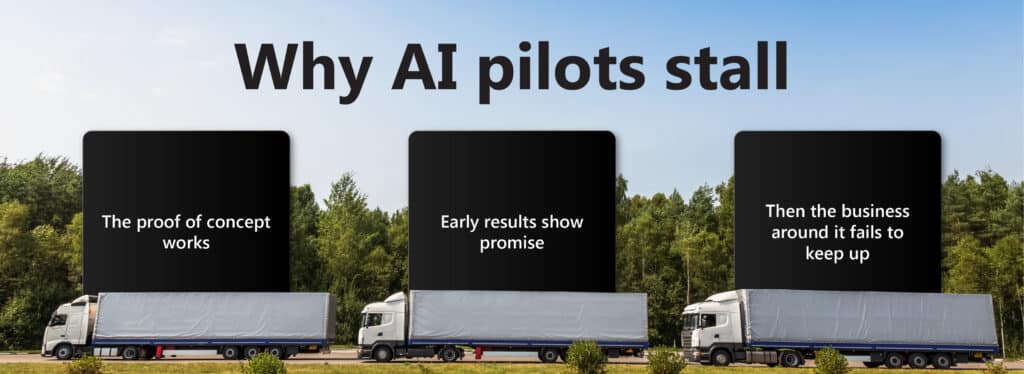
The proof of concept works. The demonstration looks impressive. Early results show promise.
Then progress slows.
Not because the AI failed.
Because the business around it was not ready to support it.
Why AI for commercial vehicle operations pilots succeed but business change does not follow
Many truck and bus organizations successfully launch AI initiatives.
They implement a chatbot. They test predictive maintenance. They introduce automated reporting. They connect a Copilot tool to selected teams.
But months later, the measurable impact is difficult to find.
The reason is straightforward.
AI for commercial vehicle operations can generate insights. It cannot automatically remove the operational barriers that prevent people from acting on those insights.
A maintenance manager might receive an AI-generated recommendation that a vehicle is likely to require servicing. But if work orders, parts inventory, technician schedules, and customer communications sit in separate systems, the recommendation creates awareness without creating action.
The insight exists. The workflow does not.
This is the gap that prevents AI from delivering real business value in commercial vehicle operations, and it is more common than most vendors acknowledge.
What is the difference between an AI insight and business value?
This is one of the most important questions organizations should ask before investing further in AI tools.
An AI insight is a recommendation, prediction, or piece of intelligence generated by a model. Business value is the measurable outcome that results when a person or process acts on that insight.
The two are not the same thing.
Value appears when the right people can act on information immediately, within the systems they already use, without additional manual steps.
Consider a commercial vehicle service operation.
An AI model identifies a likely component failure based on vehicle history and usage patterns.
What happens next?
Can the service department automatically check parts availability? Can the workshop schedule capacity be reviewed instantly? Can customer communications be triggered automatically? Can warranty information be verified without manual investigation?
If the answer to those questions is no, the AI insight becomes another task for someone to manage manually.
The organization gains information but not efficiency.
This is why so many AI initiatives stall after the pilot phase. The technology works. The operational processes around it do not.
Where AI delivers the strongest ROI in truck and bus operations
Organizations often expect AI to transform the entire business overnight. That rarely happens, and expecting it to do so creates unrealistic success criteria.
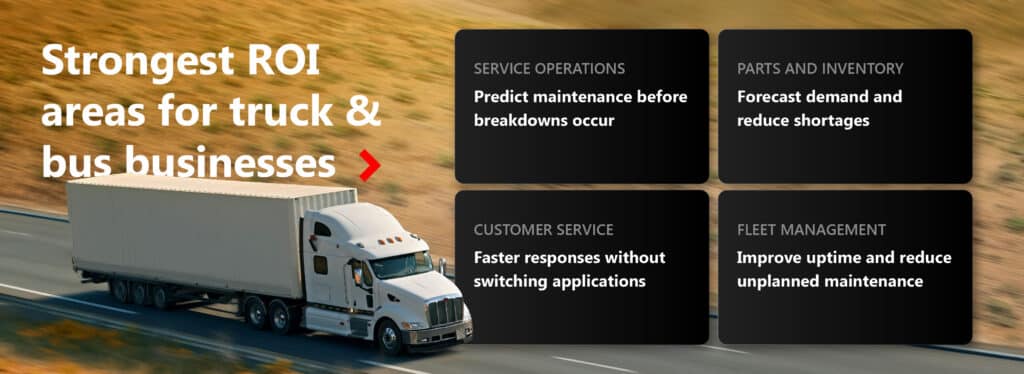
The strongest return on investment usually appears in specific operational areas first. For truck and bus businesses, those areas commonly include the following.
Service Operations
AI helps identify maintenance trends, predict service requirements, and prioritize workshop activity before issues become costly breakdowns. When connected to scheduling and parts systems, predictive maintenance recommendations can trigger real workflows rather than sitting as reports waiting to be read.
Parts and Inventory Management
AI can help forecast demand, identify stocking patterns, and reduce parts shortages that delay repairs and reduce vehicle availability. Accurate inventory intelligence is only useful when it connects directly to procurement and scheduling decisions.
Customer Service and Communication
AI-assisted responses and recommendations help teams respond faster while maintaining service quality. When customer data is connected to operational data, teams can provide more accurate and timely information without switching between applications.
Fleet and Vehicle Management
Predictive insights can improve vehicle uptime, reduce unplanned maintenance, and support more effective asset utilization. Connecting telematics data, service history, and operational schedules creates the foundation for meaningful AI-driven decision-making.
The common factor across all of these examples is not the AI itself. It is the ability to connect data, processes, and teams around the insight so that action can follow immediately.
Disconnected systems are the real barrier to AI success in commercial vehicle businesses
Many truck and bus organizations still operate across multiple disconnected applications, and this is the single biggest reason AI initiatives underperform.
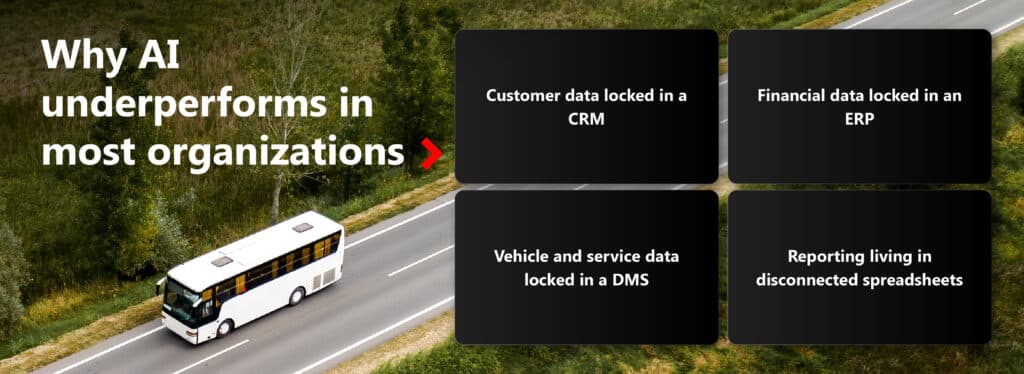
Customer information sits in a CRM. Financial information sits in an ERP. Vehicle and service data sit in a DMS. Operational reporting often lives in spreadsheets created to bridge the gaps between systems.
When data is fragmented across these sources, AI struggles to deliver meaningful business outcomes. The challenge is not generating intelligence. The challenge is giving AI a complete picture of the business and ensuring the resulting insights reach the people who can act on them.
Without connected systems, AI frequently becomes another layer added on top of existing operational complexity. Instead of simplifying decisions, it creates additional work. Teams end up managing AI outputs alongside the manual processes they were meant to replace.
Addressing this fragmentation is not a technology project in isolation. It requires examining how data flows across the organization, where handoffs break down, and which processes are genuinely ready to act on AI-generated intelligence.
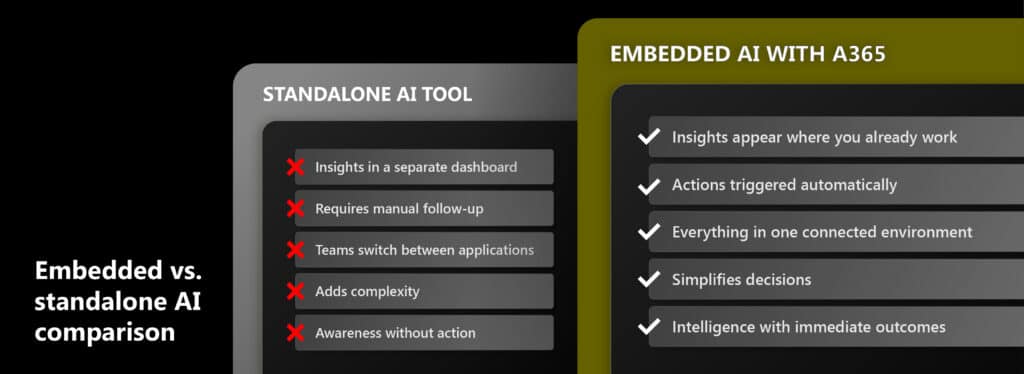
How embedded AI delivers better results than standalone tools
The most successful AI initiatives in commercial vehicle operations do not feel like separate projects. They become part of how work gets done every day.
When AI is embedded directly into operational workflows, several things change.
Insights appear where employees already work, rather than in a separate dashboard or reporting tool. Decisions happen faster because the context needed to act is already present. Actions can be taken immediately without switching applications or waiting for information to be exported and shared.
Instead of asking teams to change their behavior, AI adapts to the processes that already exist and improves them from within.
This is where organizations begin to see measurable value. Not because the AI is more advanced, but because it becomes easier to use and harder to ignore.
How A365 connects AI to commercial vehicle operations
Rather than asking what AI for commercial vehicle operations tool to buy next, the most forward-thinking truck and bus businesses are starting by examining how information moves across the organization and where the gaps are.
A365 helps commercial vehicle businesses connect ERP, CRM, and DMS processes within a unified operational environment built on Microsoft Dynamics 365. With a connected data foundation through Microsoft Dataverse, organizations gain greater visibility across departments while creating the conditions AI needs to deliver meaningful outcomes.
Using Azure, Copilot, Power Platform, and Dataverse, AI capabilities are embedded directly into operational workflows rather than existing as standalone tools sitting outside the processes people use every day.
In practice, this means maintenance insights can support service planning in real time. Customer information can inform operational decisions without manual data transfer. Inventory visibility can influence purchasing and scheduling as conditions change. And teams can act on intelligence without leaving the systems they already rely on.
The result is not a smarter AI tool. It is a smarter operation.
Related reading: What happens when commercial vehicle OEM integration isn’t aligned with ERP, CRM, and DMS
AI is not the destination. Connected operations are.
The commercial vehicle industry does not need more AI experiments. It needs more operational outcomes.
The organizations seeing the greatest success with AI are not necessarily using the most advanced technology. They are creating connected environments where data, people, and processes work together in a way that makes acting on AI intelligence the path of least resistance.
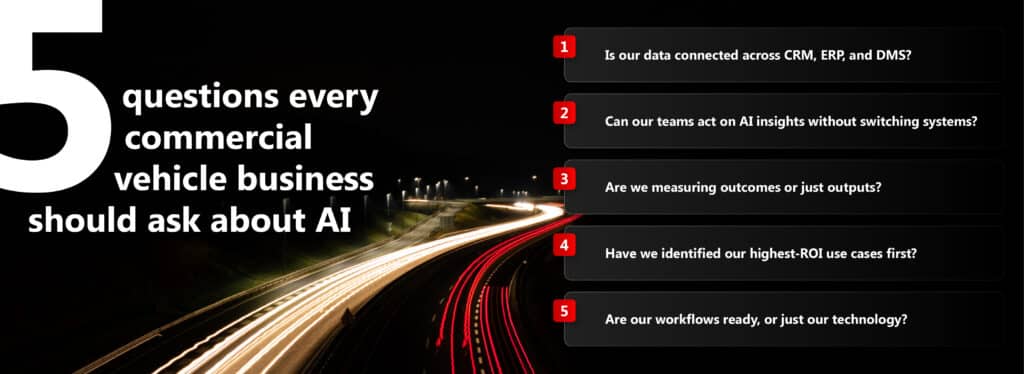
AI is not the hard part. Building the connected foundation that needs to deliver value is where the real work begins. And that is where the real competitive advantage is found.
Ready to build the connected foundation using AI for commercial vehicle operations? Explore how A365 helps commercial vehicle businesses turn insights into action with us by booking a personalized demo.
FAQ: AI for commercial vehicle operations
Why do so many AI projects in the commercial vehicle industry fail to deliver ROI?
Most AI for commercial vehicle operations projects fail not because of the technology, but because the business processes around them are not ready. When data sits in disconnected systems and teams cannot act on AI insights within their existing workflows, the technology creates awareness without creating efficiency. Integration, not intelligence, is usually the limiting factsor.
What is the most valuable use of AI for commercial vehicle operations?
The highest-value applications tend to be predictive maintenance, parts demand forecasting, and service scheduling optimization. These areas produce measurable outcomes quickly when AI is connected to the operational systems that drive action, such as workshop scheduling, inventory management, and customer communications.
What is the difference between AI in a pilot and AI at scale?
A pilot tests whether AI can generate useful insights in isolation. Scaling AI means embedding those insights into the workflows, systems, and decisions that run the business every day. The gap between the two is almost always about data connectivity and process readiness, not the capability of the AI model itself.
How does Microsoft Dynamics 365 support AI for commercial vehicle operations?
Microsoft Dynamics 365 provides a connected operational environment that brings together ERP, CRM, and service management data. Combined with Microsoft Dataverse, Azure, and Copilot, it allows AI capabilities to be embedded directly into the workflows truck and bus businesses already use, rather than adding a separate AI layer on top of fragmented systems.
What is A365 and how does it help with AI for commercial vehicle operations?
A365 is a solution built on Microsoft Dynamics 365 specifically designed for the commercial vehicle industry. It connects the core operational systems that truck and bus businesses rely on, creating the unified data foundation that AI requires to move from generating insights to driving real business outcomes.
How long does it take to see ROI from AI in commercial vehicle operations?
Organizations that focus on embedding AI into specific, high-value workflows such as predictive maintenance or parts management typically see measurable results within the first few months. Broader transformation takes longer, but starting with connected, targeted use cases creates early wins that build confidence and momentum across the business.
Do I need to replace my existing systems to benefit from AI?
Not necessarily. The priority is connectivity rather than replacement. Solutions like A365 are designed to integrate with existing DMS, ERP, and CRM environments, creating a unified data layer that enables AI to function effectively without requiring a wholesale system change from day one.