TL;DR
Most heavy equipment field service delays are not caused by technician skill gaps. They are caused by disconnected systems, when field mechanics can’t see asset history, parts availability, or warranty status from the job site. A365 Field Mechanic connects field teams to the same live operational data used by workshop, inventory, and back-office teams, eliminating the information gaps that slow service down.
Markets: Canada, the United States, the Netherlands, and international markets
In heavy equipment field service, speed isn’t just operational efficiency. It’s customer trust. It’s machine uptime.
Your heavy equipment field service isn’t slow. It’s disconnected.
For heavy equipment businesses across North America, Canada, Europe, and beyond, the same story plays out every day on job sites. A field mechanic arrives on site for what should have been a straightforward repair.
But before the work even begins, the delays start.
The service history is incomplete.
The parts list is outdated.
The technician can’t see whether the replacement component is in stock.
Someone back at the office still needs to confirm warranty details.
The customer calls asking for an update while the team is still piecing together information from three different systems.
This isn’t a technician problem.
It’s not a skills problem.
It’s what happens when heavy equipment field service operates without connected visibility.
The hidden cost of disconnected heavy equipment: Field operations
Most heavy equipment field service inefficiencies don’t look dramatic from the outside. They show up in smaller moments throughout the day, moments that, when multiplied across dozens of field mechanics, hundreds of work orders, and multiple service regions create the kind of operational drag that quietly erodes profitability.
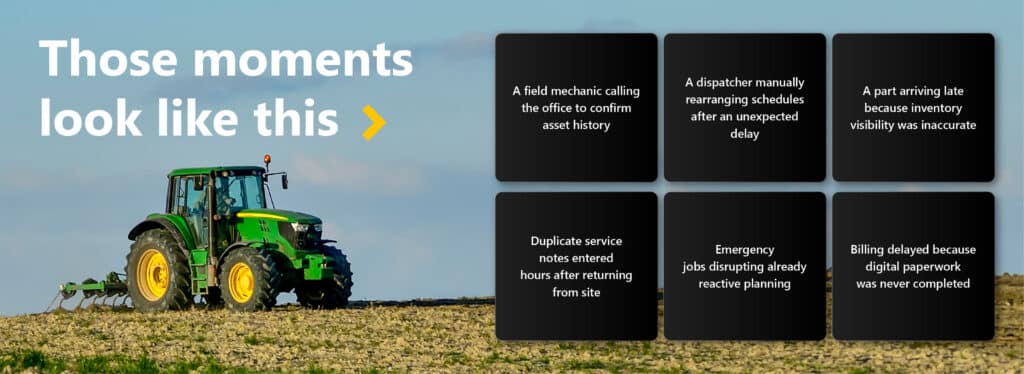
- A field mechanic calling the office to confirm asset history
- A dispatcher manually rearranging schedules after an unexpected delay
- A part arriving late because inventory visibility was inaccurate
- Duplicate service notes entered hours after returning from site
- Emergency jobs disrupting already reactive planning
- Billing delayed because digital paperwork was never completed
Individually, each moment seems manageable.
Across an entire heavy equipment operation, they add up to rising operational costs, reduced technician productivity, lower first-time fix rates, and frustrated customers who feel the disconnect in real time.
In the equipment industry, where machine uptime directly impacts customer revenue, those delays are never just internal problems. They become your competitive disadvantage.
What heavy equipment field service actually needs: Connected visibility
The businesses closing this gap aren’t doing it by hiring more staff or working longer hours.
They’re doing it by connecting their systems.
Connected heavy equipment field service gives heavy equipment technicians access to the same live operational data used by workshop teams, parts departments, and back-office staff, without manual updates, spreadsheets, or phone calls trying to fill information gaps.
That changes how decisions get made in the field.
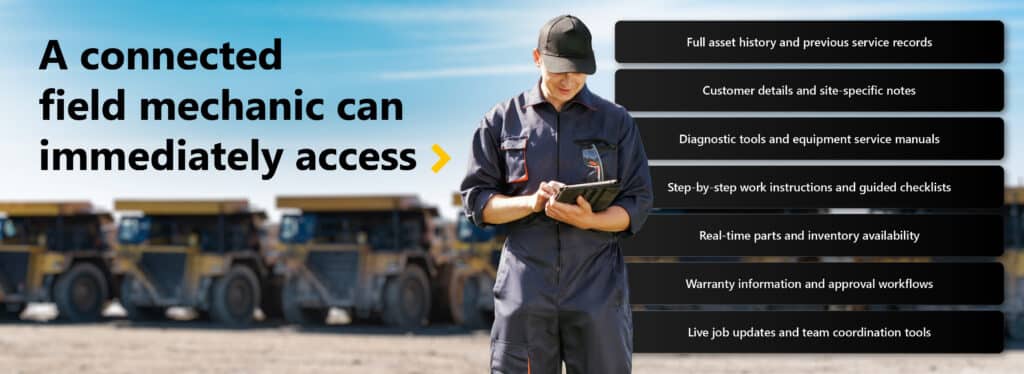
- Full asset history and previous service records
- Customer details and site-specific notes
- Diagnostic tools and equipment service manuals
- Step-by-step work instructions and guided checklists
- Real-time parts and inventory availability
- Warranty information and approval workflows
- Live job updates and team coordination tools
When information visibility improves, coordination improves with it. Scheduling becomes easier. Parts teams respond faster. Managers no longer rely on delayed reporting to understand what’s actually happening in the field across Canada, the US, the UK, or continental Europe.
The work moves faster because the information moves faster.
Reactive field service is expensive, especially for heavy equipment
Many heavy equipment businesses still default to reactive service:
A machine breaks down. A technician is dispatched. The team works around the disruption.
But reactive service becomes structurally expensive when disconnected ERP, CRM, and DMS systems prevent operations from identifying patterns before issues escalate.
This is where connected operational data changes the conversation, and where AI becomes a genuine productivity tool rather than a marketing talking point.
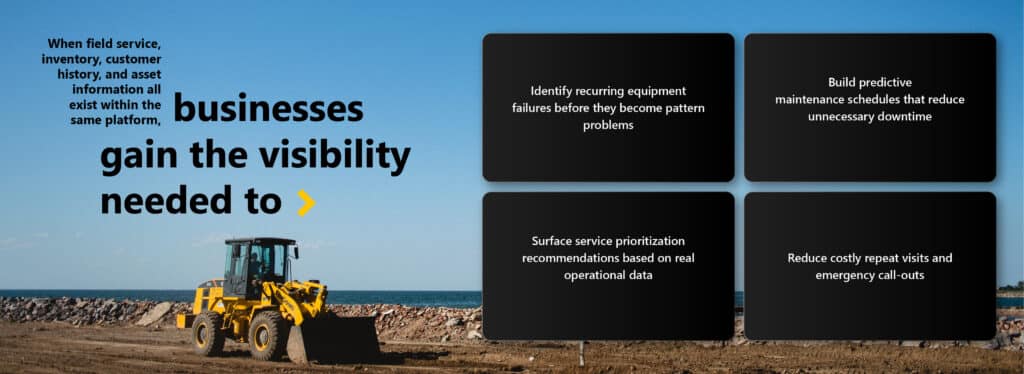
- Identify recurring equipment failures before they become pattern problems
- Build predictive maintenance schedules that reduce unnecessary downtime
- Surface service prioritization recommendations based on real operational data
- Reduce costly repeat visits and emergency call-outs
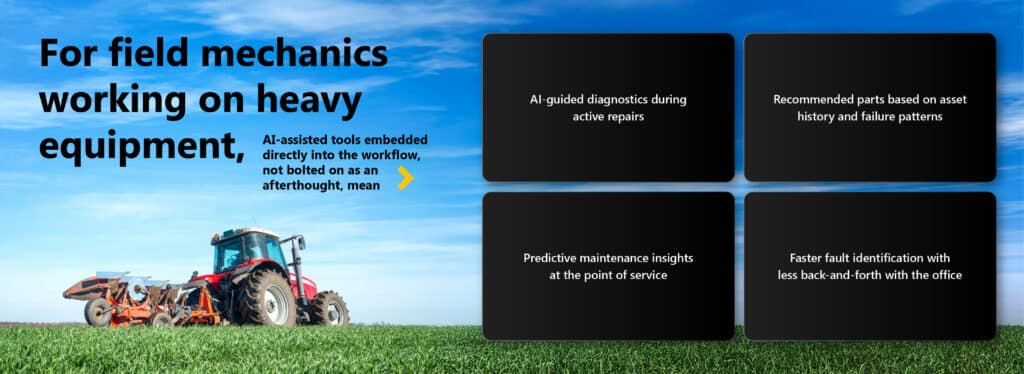
- AI-guided diagnostics during active repairs
- Recommended parts based on asset history and failure patterns
- Predictive maintenance insights at the point of service
- Faster fault identification with less back-and-forth with the office
The goal isn’t to replace skilled field mechanics. The goal is to reduce the operational friction around them so that skilled people can do what they do best.
Why ERP, CRM, and DMS alignment is the real fix
Most field service delays are coordination problems wearing the costume of service problems.
The technician may be ready.
The customer may be waiting.
But the ERP isn’t talking to the DMS. The DMS isn’t connected to inventory. And the CRM holds customer history that nobody in the field can see.
This misalignment is especially common in heavy equipment operations where service, inventory, scheduling, finance, and customer management each evolved their own tools independently.
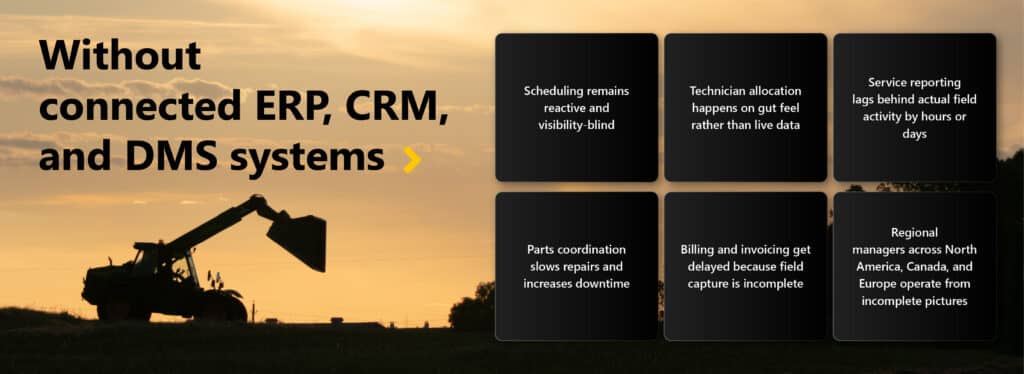
- Scheduling remains reactive and visibility-blind
- Technician allocation happens on gut feel rather than live data
- Service reporting lags behind actual field activity by hours or days
- Parts coordination slows repairs and increases downtime
- Billing and invoicing get delayed because field capture is incomplete
- Regional managers across North America, Canada, and Europe operate from incomplete pictures
Over time, businesses normalize these inefficiencies because they become part of daily operations.
But operational friction shouldn’t be considered normal, and in a competitive heavy equipment market, it doesn’t have to be.
What connected heavy equipment field service looks like with A365
This is where A365 Field Mechanic changes the experience for equipment businesses ready to close the gap.
Built specifically for the heavy equipment industry, A365 Field Mechanic connects field mechanics directly to the same intelligent operational platform used across workshop operations, inventory management, customer management, ERP, CRM, and DMS functions.
Instead of managing disconnected tools and chasing updates by phone, field teams work from live operational data, wherever the job takes them, whether that’s a construction site in Ontario, an industrial facility in the Netherlands, or a remote location across the American Southwest.
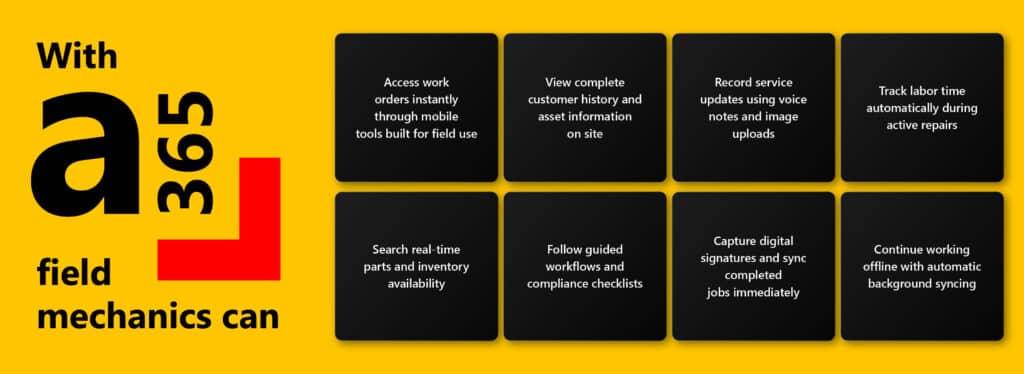
- Access work orders instantly through mobile tools built for field use
- View complete customer history and asset information on site
- Record service updates using voice notes and image uploads
- Track labor time automatically during active repairs
- Search real-time parts and inventory availability
- Follow guided workflows and compliance checklists
- Capture digital signatures and sync completed jobs immediately
- Continue working offline with automatic background syncing
The platform also supports appointment scheduling, workflow monitoring, diagnostic tools, service documentation, quality assurance, billing, invoicing, and resource allocation, all within a single connected operational environment.
Because A365 is built on Microsoft technologies, including Microsoft Dynamics 365, Azure, Copilot, Power Platform, and Dataverse, heavy equipment businesses operate within a familiar, enterprise-grade, secure, and continuously evolving ecosystem. The integration depth with Microsoft Dynamics 365 and Azure means data flows intelligently across the operation rather than sitting in isolated silos.
The result isn’t just better heavy equipment field service software.
It’s a more connected operation where field mechanics, service coordinators, parts teams, and business leaders across North America, Canada, and Europe are all working from the same operational reality, in real time.
Your field service doesn’t need more effort. It needs better visibility.
Most heavy equipment businesses don’t struggle because their field mechanics lack skill or commitment.
They struggle because disconnected systems slow decisions down, in the field, in the workshop, and across the business.
When ERP, CRM, DMS, inventory, service records, and customer data all exist within a connected operational environment, the entire business runs differently. Field mechanics resolve issues faster. Service coordinators plan with confidence. Parts teams respond to actual demand. Business leaders see real performance across every region.
Because when your systems talk to each other, technicians spend less time searching for answers and more time solving problems. And in heavy equipment field service, speed isn’t just operational efficiency.
It’s customer trust.
It’s machine uptime.
That’s what becomes possible when heavy equipment field service mechanics, parts, operations, and customer data work together inside A365.
FAQ: Connected heavy equipment field service
What is connected heavy equipment field service?
Connected heavy equipment field service means field mechanics have real-time access to asset history, parts availability, customer records, ERP data, and job status from the field, eliminating the delays caused by disconnected systems.
How does ERP integration improve field mechanic productivity?
When ERP, CRM, and DMS systems share a single data environment, field mechanics spend less time chasing information and more time completing work. First-time fix rates improve, repeat visits decrease, and billing cycles shorten.
What is A365 Field Mechanic?
A365 Field Mechanic is Annata’s purpose-built heavy equipment field service application for the heavy equipment industry. It connects technicians to live operational data via Microsoft Dynamics 365, Azure, Copilot, Power Platform, and Dataverse, supporting mobile work orders, inventory visibility, AI-assisted diagnostics, offline capability, and full service documentation.
Does A365 support equipment businesses operating in multiple countries?
Yes. A365 supports multi-region equipment operations across North America, Canada, Europe, and beyond, with the scalability and security provided by Microsoft Azure.
How does AI improve heavy equipment field service?
AI embedded within the service workflow, not added as an external tool, helps field mechanics with diagnostic guidance, parts recommendations, predictive maintenance insights, and service prioritization. Microsoft Copilot within the A365 environment enables this directly within the technician’s workflow.