Commercial vehicle OEM integration plays a critical role in the trucks, buses, and commercial vehicles industry. It connects dealers, distributors, and service operations with manufacturers, supporting everything from parts ordering to warranty processing and diagnostics.
Yet for many businesses, it does not fully deliver.
Data does not align. Systems do not sync. And what should simplify operations often adds friction instead.
Where things start to go wrong
Most OEM integrations sit on top of systems that were never designed to work together.
ERP, DMS, CRM, and service platforms often operate independently. Each holds its own data, follows its own structure, and evolves separately.
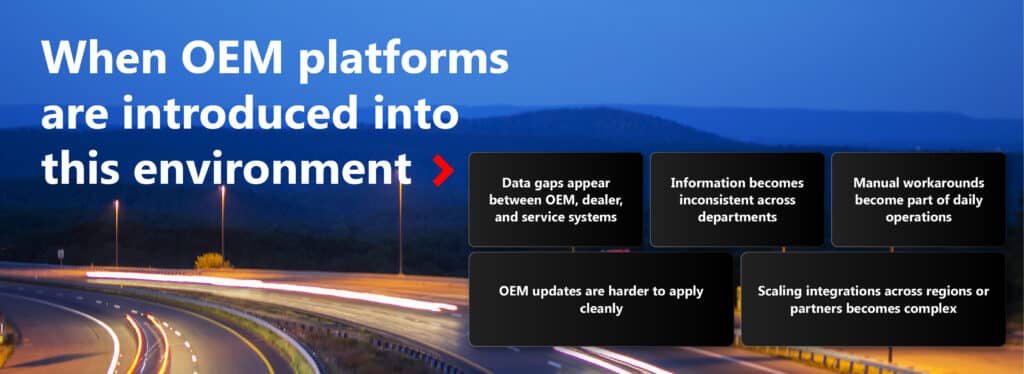
This creates more than technical challenges. It affects how the business runs day to day.
According to Market Research 2026, OEM integration is becoming a core requirement in commercial vehicle operations as businesses move toward real-time visibility across ERP, CRM, and DMS systems.
Why commercial vehicle OEM integration alone does not solve it
Connecting systems is only one step. What matters is how well those systems align underneath.

Imagine an OEM integration that built on top of three separate platforms, an ERP that holds parts and finance data, a DMS that runs dealer and service operations, and a CRM that manages customer and sales data, inherits the gaps between those platforms. Parts availability that is not reflected in the DMS. Warranty claims that do not match ERP records. Customer service histories that are not visible at the service counter.
Even well-designed integrations struggle to perform consistently in this kind of environment.
A more practical way forward
The real shift happens when the foundation changes. At Annata, we approach OEM integration as part of a unified operational environment through A365.
Running on Microsoft Dynamics 365, A365 brings ERP, DMS, CRM, and service operations into one platform. This creates a consistent base where integrations can operate more reliably and where AI can work across the full business, not in isolated pockets.
Connected commercial vehicle OEM integrations, without added complexity
Our commercial vehicle OEM integrations are designed to connect, synchronize, and optimize systems. A365 works with existing solutions while establishing a stronger and more unified architecture that aligns with OEM requirements.
At the same time, it enables AI to run across connected workflows instead of isolated systems.
Standardized, modular, and adaptable
Integration packages are built on a standardized framework that supports a wide range of OEM specifications.
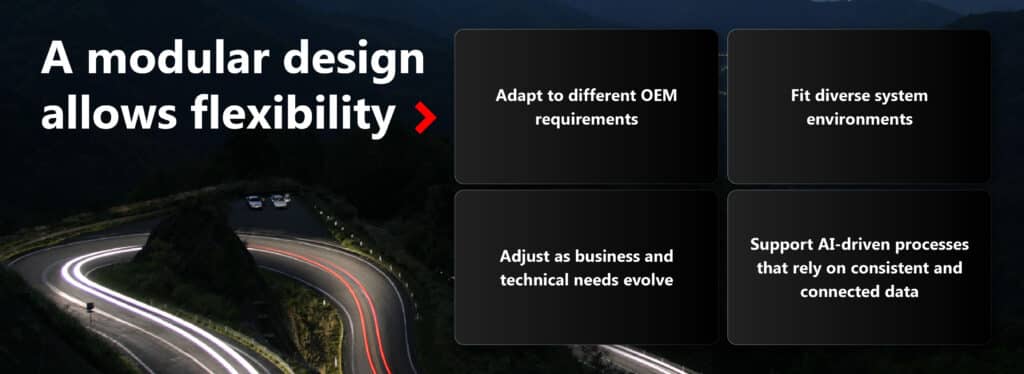
This balance between structure and flexibility reduces complexity while enabling scale.
A365 OEM integration: built for consistency, maintained over time
Using standardised data models and unified communication protocols, A365 supports consistent integration across multiple OEM platforms.
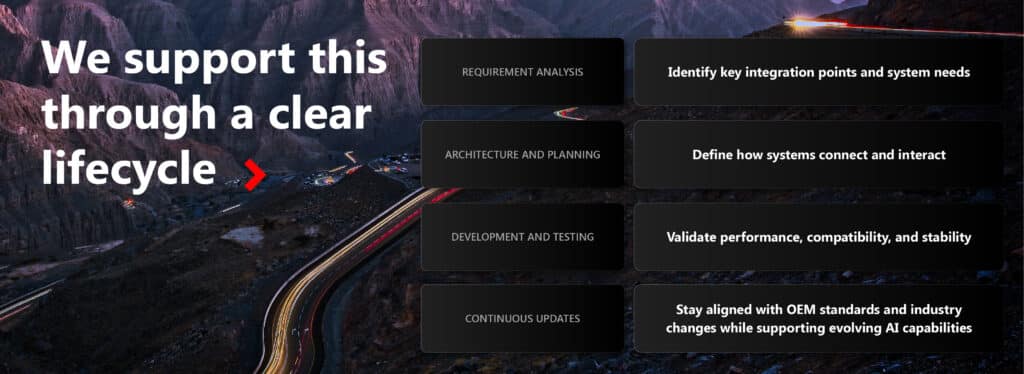
Integration packages are built on a standardised framework that supports a wide range of OEM specifications, balancing structure with the flexibility to adapt as requirements change.
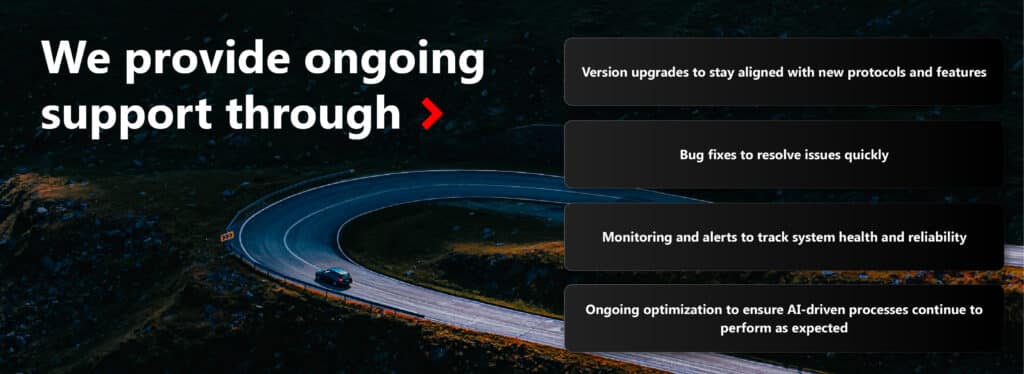
Annata’s Advanced Services team provides ongoing integration support, ensuring A365 OEM connections remain stable as systems, regulations, and OEM requirements evolve. This includes continuous investment in research and development for commercial vehicle OEM integration, supported by a global team with deep experience across trucks, buses, and commercial vehicles.
From complexity to consistency
Commercial vehicle OEM integration will always be a core part of how commercial vehicle businesses operate. The difference is how well systems align behind the scenes.
When ERP, CRM, and DMS work from the same foundation, integration becomes more predictable, scalable, and reliable. AI can then operate across the business with the right context, supporting faster decisions and more consistent execution.
That is when operational improvements start to show.
See how it works in practice
Reading about it is one thing. Seeing how it actually works across real workflows is where it becomes clear.
Visit the Annata Digital Experience Centre to explore how A365 connects ERP, DMS, CRM, OEM integrations, and AI in one environment, and how that impacts daily operations across sales, service, finance, and beyond.
Prefer something more tailored to your business needs? Get in touch with our team for a personalized demo and see how A365 can support your specific commercial vehicle OEM integration needs.