
In the automotive industry, contracts are everywhere: service agreements, fleet maintenance terms, warranty extensions, leasing arrangements, supplier commitments, and dealer incentives.
But for most automotive businesses, those contracts still operate in isolation.
They sit in folders, inboxes, shared drives, and disconnected systems that have little connection to the day-to-day operations they’re meant to support. The result isn’t just administrative inefficiency. It creates operational blind spots that directly impact revenue, compliance, customer service, and strategic decision-making across the entire business.
The problem usually isn’t the contract itself. The problem is how disconnected it is from the rest of the organization.
And in an industry where timing, service performance, and real-time visibility matter more than ever, disconnected automotive contract management is becoming increasingly difficult and costly to sustain.
What is automotive contract management, and why does it matter?
Automotive contract management is the process of creating, tracking, executing, and renewing contracts across every part of an automotive business, including dealer networks, fleet operators, service centers, OEM suppliers, and leasing operations.
When automotive contract management is connected to operational systems like ERP, CRM, and DMS platforms, businesses can act on contract data in real time. When it isn’t, gaps in visibility create revenue risk, compliance exposure, and poor customer experiences.
- Disconnected contracts create revenue leakage across the business
Many automotive businesses look for revenue leakage from a finance perspective. But the root cause often starts much earlier in the process.
A missed renewal. An outdated pricing structure. A service agreement that no longer reflects actual customer usage. An approval stuck in an email chain.
When contract management is manual or fragmented, these issues are nearly impossible to identify before they affect revenue.
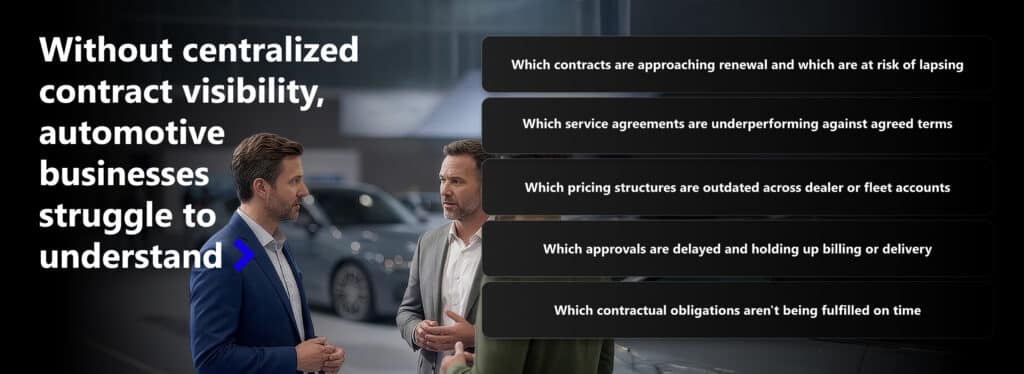
Without centralized contract visibility, automotive businesses struggle to understand:
- Which contracts are approaching renewal and which are at risk of lapsing
- Which service agreements are underperforming against agreed terms
- Which pricing structures are outdated across dealer or fleet accounts
- Which approvals are delayed and holding up billing or delivery
- Which contractual obligations aren’t being fulfilled on time
This challenge compounds significantly for businesses operating across multiple locations, dealer networks, or regional service operations. Disconnected processes create gaps, and gaps create measurable financial risk.
Why this matters for international operations: Whether you’re managing dealer contracts across North America, fleet agreements in Europe, leasing arrangements in Latin America, or supplier commitments across Asia, inconsistent contract visibility at scale accelerates revenue leakage and compliance exposure.
- Contracts that don’t connect to operations slow down every team
A contract is a commitment that directly affects pricing, services, warranties, asset management, billing, approvals, and customer expectations.
Yet in many automotive businesses, contracts are still managed separately from ERP, CRM, and DMS systems. Teams rely on manual updates, spreadsheets, or email-based approvals to keep processes moving.
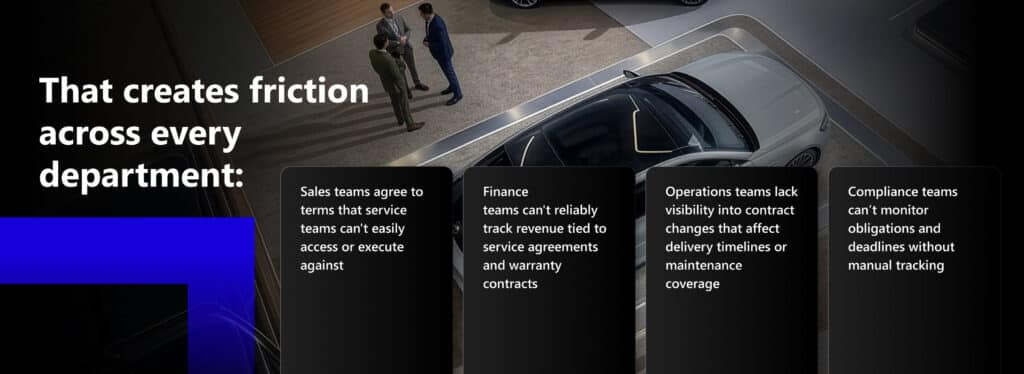
That creates friction across every department:
- Sales teams agree to terms that service teams can’t easily access or execute against
- Finance teams can’t reliably track revenue tied to service agreements and warranty contracts
- Operations teams lack visibility into contract changes that affect delivery timelines or maintenance coverage
- Compliance teams can’t monitor obligations and deadlines without manual tracking
When contracts are disconnected from operational systems, businesses lose the ability to act in real time. Delays, inconsistencies, and missed opportunities accumulate across the entire customer lifecycle.
- Lack of real-time visibility limits strategic decision-making
Automotive businesses today operate in an environment that demands agility.
Customer expectations are evolving. Service and mobility models are changing. Margins are under pressure. Regulatory and compliance requirements continue to increase across every major market.
To respond effectively, teams need more than access to documents. They need connected, real-time insight across the entire operation.
But most businesses still don’t have a single source of truth for contracts and the operational data tied to them.
Without it, teams spend time searching for information instead of acting on it, and leadership can’t easily answer critical operational questions like:
- How do contract terms affect service profitability across different dealer groups?
- Which agreements are linked to specific vehicles, assets, or customer accounts?
- What’s the operational impact of a pricing adjustment across active contracts?
- Where are approval bottlenecks slowing down service delivery or invoicing?
- Which customers are at highest risk of churn during upcoming renewal periods?
These aren’t just legal or administrative questions. They’re strategic business questions that require connected systems to answer reliably.
- Disconnected contract data degrades customer experience
Customers don’t experience contracts as standalone documents.
They experience them through service delivery accuracy, billing consistency, response times, warranty handling, and how reliably a business keeps its commitments.
When internal systems are disconnected, customers feel the impact immediately through billing errors, service delays, missed warranty claims, and inconsistent treatment across touchpoints.
When contracts are fully connected to operations, businesses can respond faster, deliver more accurately, and create consistent customer experiences at every stage of the relationship.
For automotive businesses managing high volumes of service agreements, fleet accounts, or leasing portfolios, that consistency is a direct competitive differentiator.
How connected automotive contract management software solves this
A365 Contract Management is purpose-built to help automotive businesses move beyond static contract administration and toward connected operational contract management.
Built on the Microsoft ecosystem, including Microsoft Dynamics 365, Azure, Copilot, Power Platform, and Dataverse, A365 Contract Management integrates contracts directly with ERP, CRM, DMS, financials, services, and asset data.
That integration gives automotive businesses a complete, real-time operational view across the entire contract lifecycle.
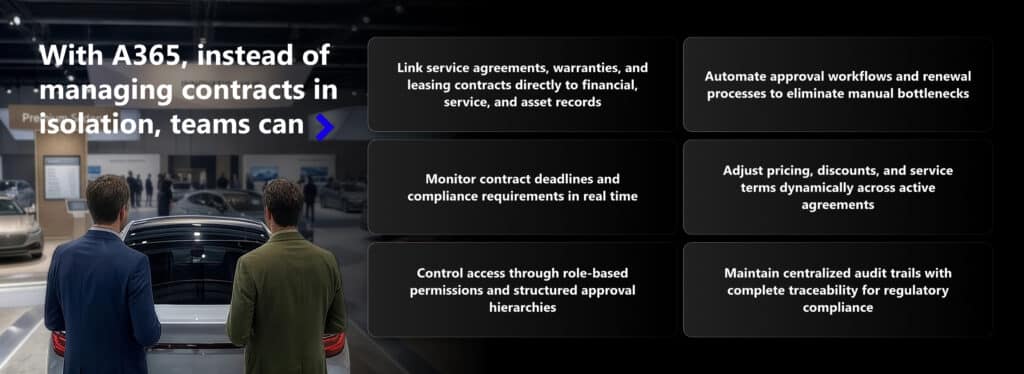
Instead of managing contracts in isolation, teams can:
- Link service agreements, warranties, and leasing contracts directly to financial, service, and asset records
- Automate approval workflows and renewal processes to eliminate manual bottlenecks
- Monitor contract deadlines and compliance requirements in real time
- Adjust pricing, discounts, and service terms dynamically across active agreements
- Control access through role-based permissions and structured approval hierarchies
- Maintain centralized audit trails with complete traceability for regulatory compliance
The result isn’t simply better contract administration. It’s a more connected, operationally intelligent business.
How AI is transforming automotive contract management
As automotive operations become more complex across more markets, more asset types, and more service models, businesses need smarter ways to manage risk, compliance, and contract performance.
AI is increasingly central to that shift.
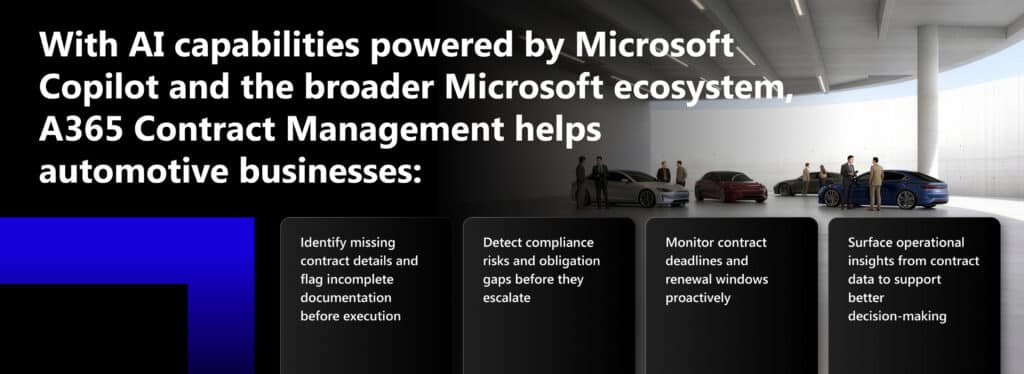
With AI capabilities powered by Microsoft Copilot and the broader Microsoft ecosystem, A365 Contract Management helps automotive businesses:
- Identify missing contract details and flag incomplete documentation before execution
- Detect compliance risks and obligation gaps before they escalate
- Monitor contract deadlines and renewal windows proactively
- Surface operational insights from contract data to support better decision-making
Instead of reactive automotive contract management, businesses can shift to proactive, data-driven operations supported by real-time AI intelligence.
Modern automotive contract management isn’t just about storing documents. It’s about understanding and acting on the operational impact behind every agreement.
The future of automotive contract management is connected and operational
The automotive industry is accelerating toward connected, data-driven operations.
Businesses are investing in AI, automation, cloud platforms, and integrated technology ecosystems to improve visibility, agility, and performance across the value chain. Contract management can’t remain disconnected from that transformation, because contracts influence nearly every part of the business.
When connected properly, contracts become more than legal agreements. They become operational drivers that support revenue growth, regulatory compliance, customer retention, and long-term business performance.
Ready to see how A365 Contract Management can connect your contracts to your operations? Request a demo →
A365 Contract Management for automotive businesses is built on the Microsoft ecosystem, including Microsoft Dynamics 365, Microsoft Azure, Microsoft Power Platform, Microsoft Dataverse, and Microsoft Copilot.
FAQ: Automotive contract management
What’s the biggest risk of disconnected automotive contract management in businesses?
The biggest risk is invisible revenue leakage. When contracts are disconnected from operational systems, businesses miss renewals, fail to enforce pricing terms, and can’t track which obligations are being fulfilled, all of which directly impact profitability.
How does automotive contract management software integrate with DMS and ERP systems?
Purpose-built automotive contract management platforms like A365 Contract Management connect directly to ERP, CRM, and DMS platforms, linking contract data to financial records, service histories, asset registers, and customer accounts. This eliminates manual data re-entry and creates a single source of truth across operations.
What is contract lifecycle management (CLM) in the automotive industry?
Contract lifecycle management (CLM) in automotive refers to the end-to-end process of managing contracts from creation and negotiation through execution, performance monitoring, renewal, and termination, across dealer networks, fleet operations, service centers, OEM relationships, and leasing portfolios.
How can AI improve automotive contract management for automotive businesses?
AI-powered contract management tools can automatically identify risks, flag missing clauses, monitor compliance deadlines, surface renewal opportunities, and provide predictive insights into contract performance, reducing reliance on manual review and enabling proactive management at scale.
Which automotive businesses benefit most from connected automotive contract management?
Any automotive business managing high volumes of contracts benefits from connected CLM, including OEMs, dealer groups, fleet operators, leasing companies, and aftermarket service providers operating across multiple locations, regions, or market segments.